
What Are the Best Mental Health Apps in India?

Key highlights
- Listennr focuses on human-to-human emotional support for people who want to talk to a real person without starting with formal therapy.
- Mental health apps in India serve different needs, including peer support, professional counselling, AI-guided tools, self-help, and mindfulness.
- Some platforms connect you with professionals, while others let you manage your mental wellbeing through self-guided tools or tracking.
- Privacy, anonymity, accessibility, and ease of starting a conversation are important factors when choosing an app.
- The right app depends on whether you want human connection, professional guidance, self-monitoring, or structured self-help.
- Free plans or trials can help you understand whether an app fits your needs before paying for additional features.
- Mental health apps can support everyday wellbeing, but they should not replace professional care when you need assessment or ongoing treatment.
You know you need to talk to someone, but that does not always mean you are ready for therapy. Maybe you do not want to explain everything to a friend, worry about being judged, or simply need someone outside your usual circle who will listen. That is a very different need from downloading a meditation or self-help app.
And that is where choosing between mental health apps can get confusing. Some connect you with therapists, some use AI, and others offer self-guided tools or peer communities. If what you are really looking for is a real person to talk to, privacy, and a conversation you can start without a formal commitment, those differences matter.
In this guide, we compare the top mental health apps available in India based on what they actually offer, how you start a conversation, who you can talk to, privacy and anonymity options, and where each platform has limitations. Most importantly, we look at which options make the most sense when what you need is not to be fixed, but simply to be heard.
What should you look for in a mental health app?
The right mental health app depends on what you need from it. If you want someone to talk to, you will need to look for something other than meditation, mood tracking, or professional care. Before signing up, consider:
- Type of support: Are you looking for a peer, a listener, a mental health professional, or an AI tool?
- Human connection: If you want to talk to a real person, check whether conversations are one-to-one, community-based, or scheduled.
- Privacy and anonymity: Look at what information you need to provide and what the platform says about protecting your conversations and identity.
- Ease of starting: Can you begin a conversation right away, or do you need to complete a profile, wait for a match, or book a session?
- Availability in India: Check whether the app and its support are available to users in India.
- Level of commitment: If you are not ready for therapy, look for platforms that let you seek emotional or peer support without requiring a formal treatment relationship.
- Cost and access: Check whether the core support is free, paid, or available through a mix of both.
The best choice is not necessarily the app with the most features. It is the one that fits the kind of support you are actually looking for and feels manageable enough to use when you need it.
What Are the Top Mental Health Apps in India?
Choosing a mental health app depends on the kind of support you want. Some offer self-help or AI tools, while others connect you with mental health clinicians, professionals, peers, or listeners. Below, we compare the top options in India by how they work, who they support, and what to expect.
1. Listennr - Best fit for human-to-human emotional support
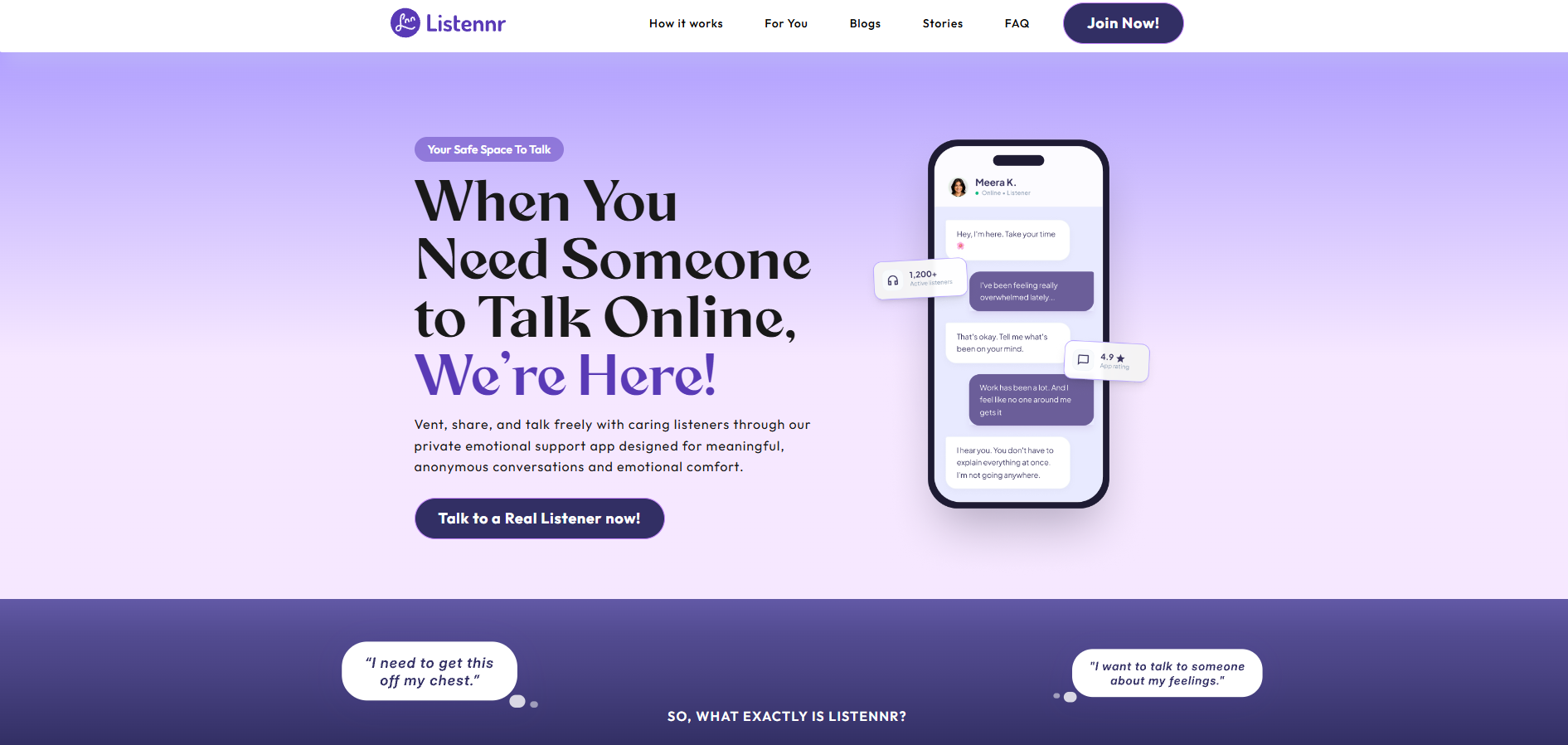
Sometimes, you do not need another exercise telling you how to cope. You simply want to talk to a real person about what is on your mind. Listennr is built around human-to-human emotional support, making it relevant for people who want to be heard rather than rely only on self-guided tools.
How does Listennr work?
Listennr gives users a space to have a human conversation around what they are experiencing. This makes it a practical option when you want to start talking instead of spending time working through a journal, meditation session, or automated tool.
Who is it best for?
- People looking for human-to-human emotional support
- Those who want someone to listen without immediately turning to formal therapy
- People who find it easier to open up outside their existing social circle
What type of support does it provide?
The focus is on listening, emotional support, and human connection, rather than diagnosis or treatment.
Availability and accessibility:
For the final article, confirm Listennr's current availability in India and the exact process for starting a conversation before publication.
Privacy and anonymity:
Use Listennr's current privacy information here. We should not describe the service as anonymous unless its current product or privacy documentation explicitly supports that claim.
Key strengths
- Human conversation is central to the experience.
- It offers an option for people who want emotional support without making formal therapy the first step.
- The listening-focused approach can feel more direct than self-guided mental wellness tools.
Limitations
- Listennr is not a substitute for professional mental healthcare.
- It should not be positioned as a crisis-support service.
- The exact privacy, availability, and conversation features should be based on current product information.
2. Clarity App - Best for anonymous conversations with listeners

If you want to talk to someone about what you are going through without entering formal counselling, Clarity App connects users with listeners for private conversations. It is designed around emotional support through real-person conversations, with options to communicate through chat, calls, or video calls.
How does Clarity App work?
Clarity App connects users with listeners who have personal experience with difficult situations and are available to listen to their concerns. Users sign up with a mobile number, choose a listener, and start a conversation using the available chat or call options.
Who is it best for?
- People looking for anonymous emotional support
- Users who want to talk to a real person about personal concerns
- Those dealing with loneliness, relationship issues, breakups, or difficult experiences
What type of support does it provide?
The primary focus is human-to-human emotional support through listeners, rather than professional counselling or AI-guided self-help. Clarity states that it does not provide professional counselling.
Availability and accessibility:
Clarity App is positioned as an India-focused emotional support platform, with listeners available to users through its app. Users can choose a listener and start a conversation after signing up.
Privacy and anonymity:
Clarity states that users remain anonymous to listeners and that their identity is not disclosed to the listener during standard use. However, users still sign up using mobile authentication, so anonymous does not mean that the platform does not have account information.
Key strengths
- Anonymous conversations with real human listeners
- Supports chat, calls, and video calls
- Designed specifically around emotional support rather than self-guided exercises
Limitations
- It does not provide professional counselling or medical care.
- Conversations with listeners are paid and charged by the minute.
- The experience can vary depending on the listener and their availability.
3. 7 Cups - Best for peer and listener emotional support
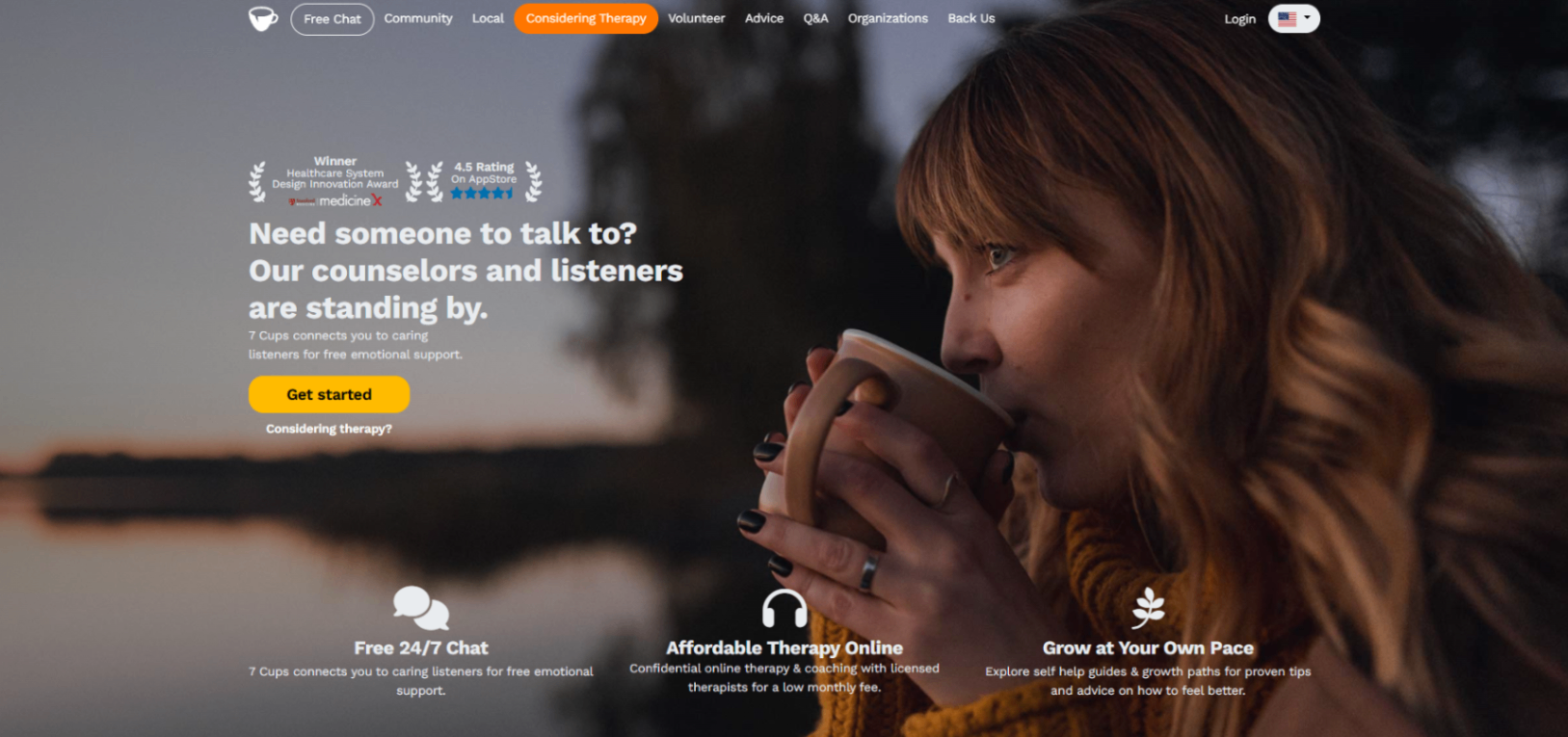
If you want to talk to someone without immediately turning to formal therapy, 7 Cups connects users with trained volunteer listeners for one-to-one emotional support. It also offers community spaces and professional therapy, giving users different ways to find support depending on what they need.
How does 7 Cups work?
7 Cups connects users with trained Active Listeners through on-demand one-to-one chats. Users can request the first available listener or browse profiles and choose someone based on factors such as topic, language, or lived experience. Listeners complete 7 Cups' active listening training and provide emotional support rather than professional therapy.
Who is it best for?
- People looking for free emotional support from trained listeners
- Users who want anonymous one-to-one conversations
- Those who prefer peer support or community spaces alongside individual conversations
What type of support does it provide?
The primary focus is emotional support through trained listeners, with additional community support and professional therapy available separately. Listener conversations are designed around active listening rather than diagnosis or treatment.
Availability and accessibility:
7 Cups is available to users in India, with a dedicated India section listing listeners and therapists. The platform also offers its listener service through its website and app, with listeners available across multiple countries and languages.
Privacy and anonymity:
7 Cups says its listener conversations are anonymous, with contact information such as phone numbers, email addresses, and social media handles blocked from being shared with listeners. Users can therefore talk to listeners without revealing their identity during the conversation.
Key strengths
- Free one-to-one conversations with trained listeners
- Anonymous emotional support
- Users can choose or request a listener based on their preferences
- Includes community spaces and professional therapy as additional support options
Limitations
- Listener support is not a substitute for professional mental healthcare.
- The experience depends on the listener you connect with and their availability.
- Users looking specifically for a simple one-to-one listening experience may find the platform's broader mix of therapy, community, self-help, and AI features more extensive than they need.
4. Wysa - Best for AI-guided mental health support
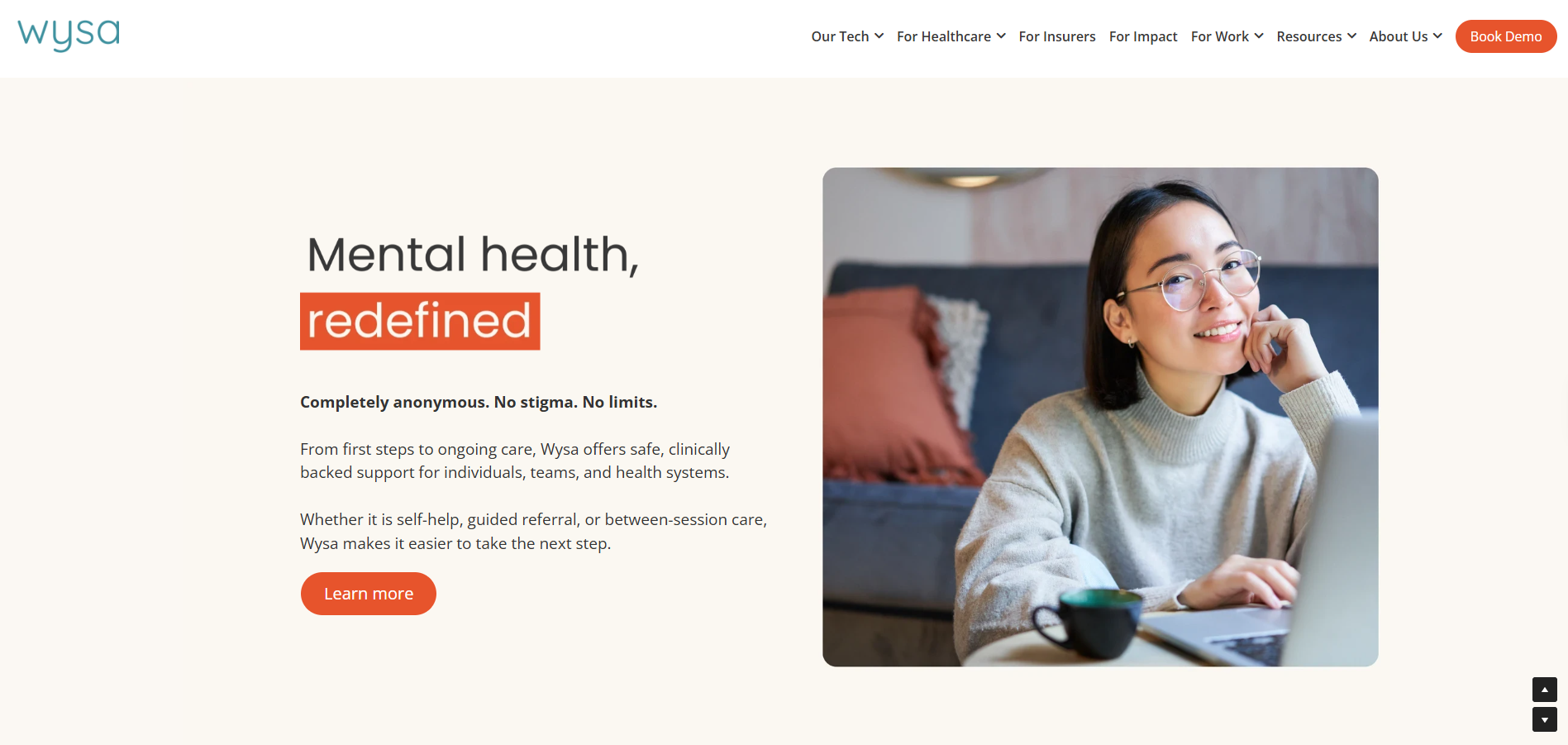
If you want support you can access on your own, Wysa takes a different approach from human-listening platforms. It uses an AI chatbot to guide users through conversations and self-help exercises, including approaches based on cognitive behavioural therapy and mindfulness.
How does Wysa work?
You interact with Wysa through a conversational chatbot, which can guide you through exercises and reflections around concerns such as stress, anxiety, and emotional wellbeing. This makes it accessible when you want support without having to wait for another person to respond.
Who is it best for?
- People who prefer AI-guided support
- Users looking for self-guided exercises for stress or anxiety
- Those who want to explore digital mental health support privately
What type of support does it provide?
Wysa primarily provides AI-guided self-help and wellbeing support, rather than peer-to-peer emotional support.
Availability and accessibility:
Verify its current availability and feature access for users in India before publication, particularly because features and plans can vary by location.
Privacy and anonymity:
Wysa has positioned its service around private digital conversations, but the article should distinguish between privacy and true anonymity and rely on its current privacy policy for specific claims.
Key strengths
- Available on demand rather than dependent on another person's availability
- Guided exercises can give users something practical to work through
- The conversational format may feel more approachable than navigating a traditional self-help program
Limitations
- The interaction is primarily with AI, not another person.
- It does not provide the same human connection as a peer or listener platform.
- Users looking specifically for someone to listen to their personal experience may need a different type of support.
5. InnerHour (Amaha) - Best for structured self-help and professional support
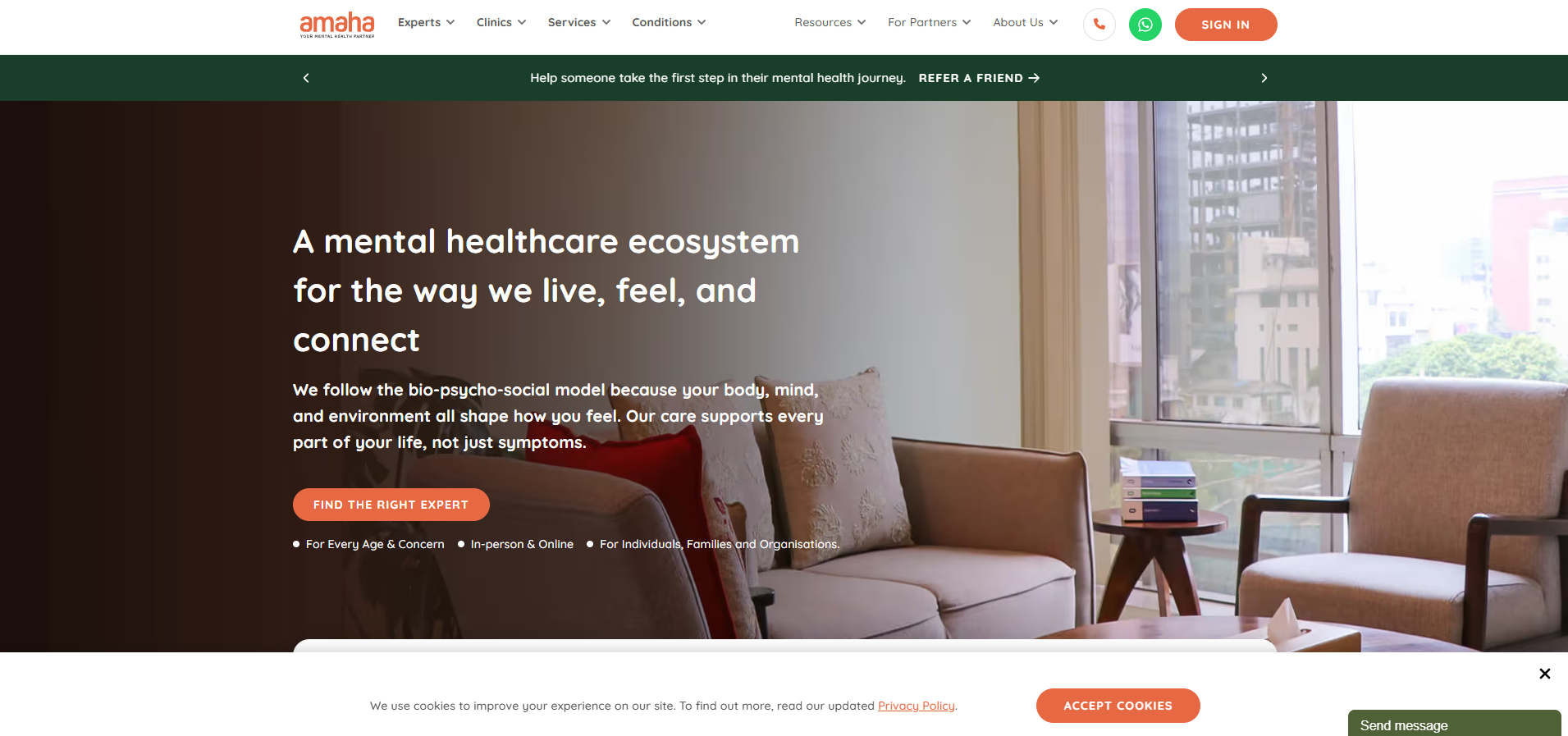
If you prefer having a clear structure rather than figuring out what to do on your own, InnerHour, now known as Amaha, combines guided self-help with access to professional mental health support, including free guided meditations. It can be useful for people who want practical tools first but also want the option of speaking with a professional when they need more support.
How does Amaha work?
The platform combines structured self-help programmes with professional support. Its tools address concerns such as anxiety, sleep difficulties, anger, and low mood, giving users a more guided approach than simply browsing general wellbeing content.
Who is it best for?
- People who prefer structured self-help
- Users looking for guided CBT-based tools
- Those who may want professional support alongside self-guided resources
What type of support does it provide?
Amaha combines self-guided mental health support with professional care, rather than focusing primarily on peer-to-peer conversations.
Availability and accessibility:
Verify the current features and availability for users in India before publication, including which services can be accessed directly through the app.
Privacy and anonymity:
Check Amaha's current privacy information before making specific claims about anonymity. Accessing professional services may also involve providing information that would not be required for an anonymous peer conversation.
Key strengths
- Structured programs can give users a clearer starting point.
- Self-help tools and professional support are available within the same platform.
- It can suit people who want the option to move from self-guided support to professional care.
Limitations
- Its focus is broader than peer-to-peer emotional support.
- Users specifically looking for an anonymous conversation with another person may prefer a listener- or peer-focused platform.
- Professional support may involve a greater level of commitment than simply starting an informal conversation.
6. YourDOST - Best for online professional counselling

If you want to speak directly with a mental health professional rather than work through an app-led programme, YourDOST focuses on online counselling and personalised support. It may suit people who want a structured conversation with a professional around concerns such as stress, work pressure, or emotional difficulties.
How does YourDOST work?
YourDOST connects users with mental health professionals for online counselling. This makes the experience more conversation-led and personalised than apps that rely mainly on self-guided exercises.
Who is it best for?
- People are looking for professional counselling and support from professional counsellors.
- Users who want personalised guidance
- Those who prefer speaking directly with a trained professional
What type of support does it provide?
The primary focus is professional mental health counselling, rather than peer-to-peer emotional support.
Availability and accessibility:
Verify the current services available to users in India before publication, including how users can access counselling and whether all features are available nationwide.
Privacy and anonymity:
Professional counselling generally requires more user information than an anonymous peer conversation. Specific privacy and account requirements should be based on YourDOST's current policies.
Key strengths
- Direct access to professional counselling
- More personalised than self-guided mental wellness tools
- Suitable for people who want ongoing professional conversations
Limitations
- It is not primarily designed around anonymous peer-to-peer support.
- Professional counselling involves a different level of commitment than simply talking to a listener.
- Someone who wants informal emotional support without entering a counselling relationship may prefer a different type of platform.
The right app is the one that matches what you need at that moment, whether you want someone to listen, a space to talk openly, professional guidance, or tools to work through things at your own pace.
How do these mental health apps compare?
The biggest difference between these apps is the kind of support you get when you need it, depending on your mental health needs. Some are designed for self-guided tools, while others connect you with professionals, communities, or real people. The table below focuses on the factors that matter most when you are deciding where to turn.The main difference between these apps is the kind of support they provide. Some connect you with listeners or peers, while others offer AI-guided tools, structured self-help, or professional counselling. The table below compares each option based on its primary support model and the type of human connection it offers.
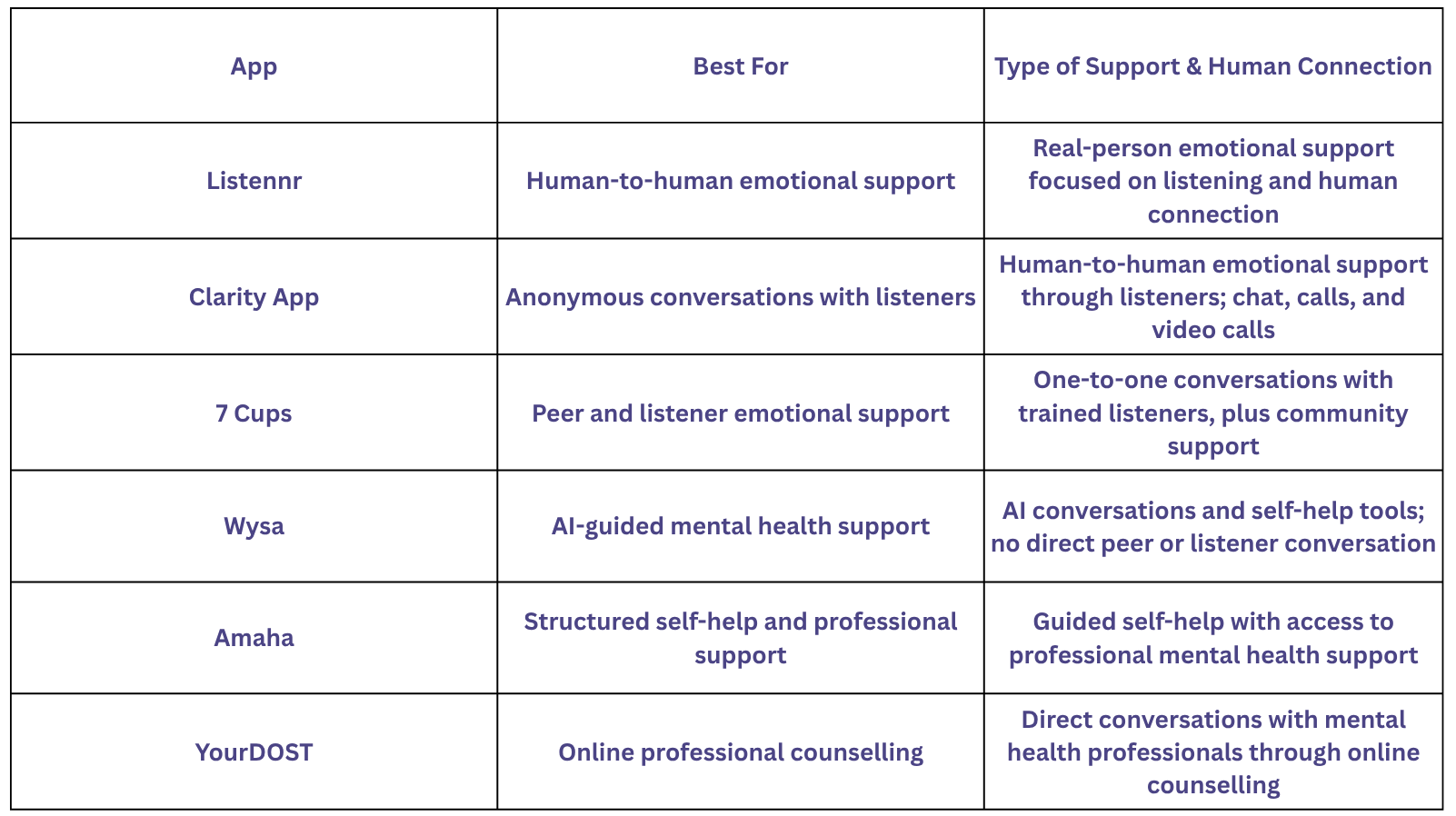
This version is much better aligned with the reviewer's comment because each app now has a distinct role, rather than comparing Listennr with unrelated tracking, mindfulness, and wellbeing apps. It also makes the reader's actual choice clearer: listener support, peer support, AI support, structured self-help, or professional counselling.
Which mental health app is right for you?
The better question is not “Which free app has the most features?” It is “What do I want to happen when I open the app?” If you want to talk through something with another person, track what you have been feeling, work through guided exercises, or speak with a professional, your starting point will be different.
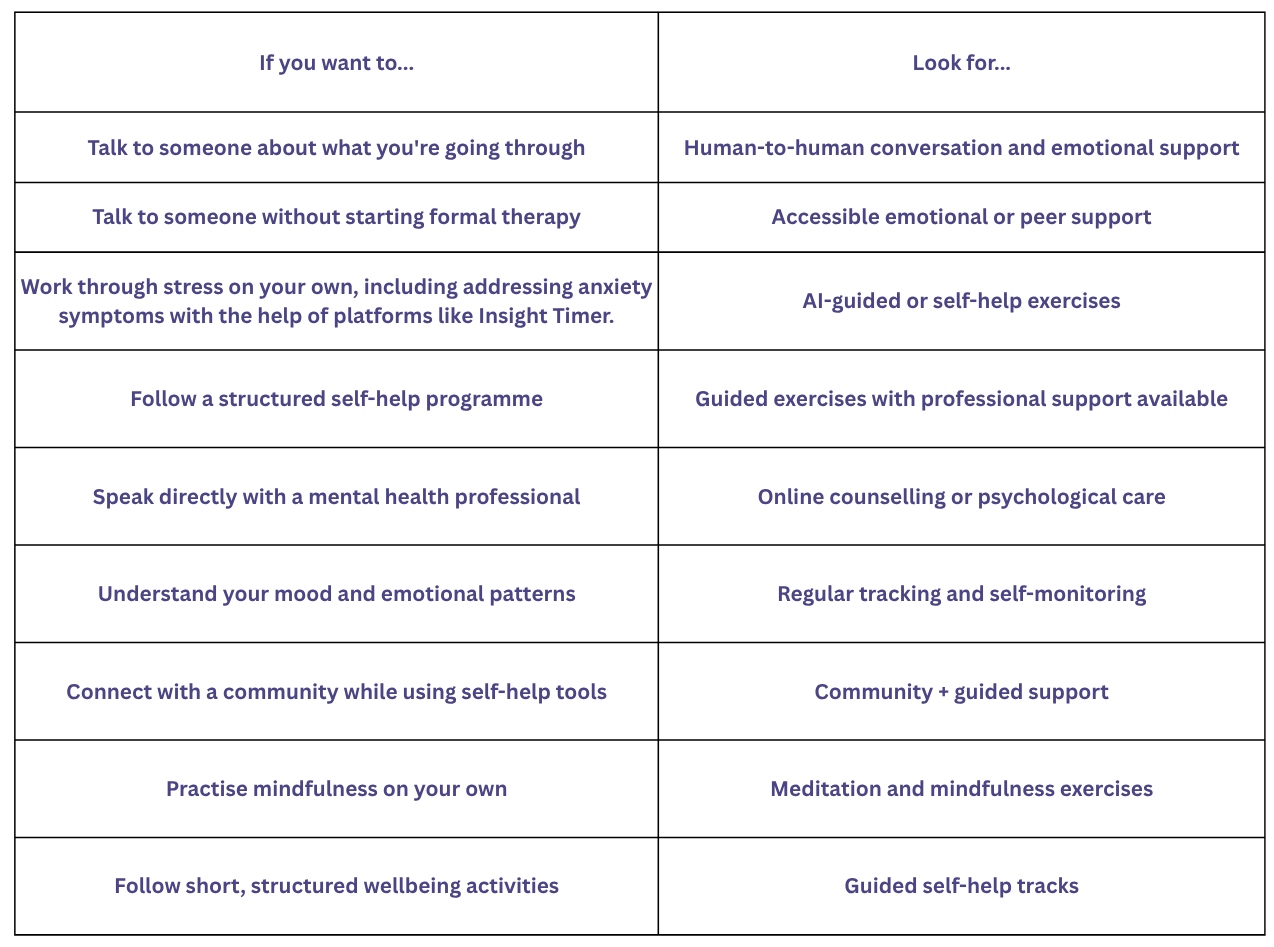
If your first thought is “I don't know if I need therapy; I just want someone to talk to,” that distinction matters. A self-help or tracking app may give you something to do, but it does not necessarily give you someone to talk to. For that specific need, Listennr is the closest fit among the options reviewed.
Is peer support the same as therapy?
It is easy to group peer support and therapy together because both can give you a place to talk. But the person you are talking to, the purpose of the conversation, and the kind of support you receive are different.
- Peer support: Focuses on listening, shared experiences, empathy, and emotional encouragement rather than diagnosis or treatment, creating a safe space for individuals to express themselves.
- Therapy: Is provided by a qualified mental health professional and may involve assessment, therapeutic approaches, and structured care.
- When peer support can help: It can be useful when you feel isolated, want to talk openly, or need someone who understands without immediately entering a formal care setting.
- When professional support may be more appropriate: If you need assessment, treatment, or ongoing care for a mental health concern, a qualified professional can provide support that peer platforms are not designed to offer.
- They can serve different roles: Choosing peer support does not mean rejecting therapy, and using therapy does not mean you cannot also benefit from supportive human connection.
The simplest distinction is this: peer support can give you a person to talk to and connect with, while therapy provides professional mental health care; the right choice depends on what you need from the conversation.
Can you talk to someone anonymously through a mental health app?
Yes, some mental wellness apps offer anonymous or privacy-focused ways to seek support, but “anonymous” does not mean the same thing on every platform. If you are worried about being judged, recognised, or having a personal conversation attached to your identity, checking the privacy details before signing up can make the experience feel more comfortable.
- Check what information is required: Does the app ask for your real name, phone number, email address, or other identifying details?
- Look at the type of support: An app may offer anonymous community posts or chats while requiring identification for professional counselling.
- Check how conversations work: Find out whether you speak one-to-one with another person, post in a community, use an AI chatbot, or work through self-guided tools.
- Read the privacy policy: Look for clear information about what personal data and conversations are collected, stored, and shared.
- Do not assume private means anonymous: An app can keep conversations private while still requiring an account or collecting identifying information.
- Consider what you actually need: If your main goal is to talk openly with a real person, anonymity is only one part of the decision; the type of support and ease of starting the conversation matter too.
Before sharing something deeply personal, check exactly what the platform means by “anonymous” or “private” so you know what information you are providing and who may have access to it.
When is a mental health app not enough?
A mental health app can be a useful place to start, but there are times when an app cannot give you the level of support you need. If what you are experiencing is persistent, getting harder to manage, or beginning to interfere with everyday life, it may be time to involve a qualified mental health professional.
- Your concerns are lasting or getting worse: If difficult thoughts, emotions, or anxiety symptoms continue despite trying self-guided support, consider speaking with a professional.
- Daily life and quality of life are being affected: Changes in sleep, work, relationships, studies, or your ability to manage everyday responsibilities are signs that additional support may be useful.
- You need assessment or treatment: Apps can offer exercises, conversations, tracking, or general support, but they cannot replace professional assessment and care.
- You need ongoing support: A professional can help you understand what you are experiencing and determine what kind of care may be appropriate.
- You feel unsafe or are in immediate danger: An app should not be your only source of help. Seek urgent professional or emergency support appropriate to your situation.
An app does not have to be your final answer. If what you are dealing with is becoming difficult to manage on your own, reaching out to a qualified professional is a sensible next step.
Conclusion
Choosing the right mental health app is less about finding the one with the most features and more about finding the kind of support you actually need. Some apps help you talk to a real person, while others offer professional guidance, AI-based support, self-help tools, or mindfulness techniques to understand your emotions. The right choice is the one that feels comfortable and useful for where you are right now.
If you know you want someone to talk to but are not ready for formal therapy, a human conversation can be a simple place to start. And if what you are experiencing is becoming difficult to manage or affecting your everyday life, reaching out to a qualified mental health professional, including professional counselors, can give you more appropriate support. You do not have to figure everything out at once; taking one manageable step toward support is enough.
Frequently asked questions
Are mental health mobile apps reliable for emotional support in India?
Yes, they can be useful for emotional awareness and support in India, particularly in terms of stress management, but their reliability depends on the type of support offered, including whether the app features sleep stories. Check whether the app provides real human connection, qualified professionals, clear privacy policies, and appropriate support for your needs.
Do these apps provide only peer support or professional help too?
Some offer peer or community support, while others provide professional counselling, therapy, AI-guided tools, or self-help resources for those dealing with substance use disorder. The right choice depends on whether you want human connection, expert care, mental health treatment, or self-guided support.
What are users saying about their experience with top mental health apps?
User experiences vary, but common feedback focuses on ease of use, helpful features, privacy, and whether the support feels genuinely useful for addressing mental health conditions. Reviews can offer useful context, but they should not replace checking an app’s features and support model.
What features should I look for in a mental health app?
Look for the type of support you need, along with clear privacy policies, anonymity options, availability in India, cost, and how easily you can start a conversation or access the support you need.
How reliable are mental health apps according to psychiatrists?
Mental health apps can be useful, but psychiatrists and clinical psychologists recommend looking beyond popularity or app-store ratings. Check the app’s evidence, privacy protections, professional involvement, safety features, and whether it complements rather than replaces appropriate professional care; consider also their favourite mental health app recommendations for a more informed choice.
Are there mental health apps designed to help during crises or pandemics?
Yes. Some digital mental health tools, like those involving a virtual pet, provide self-help, remote support, or access to care during crises when in-person services may be harder to reach on your mental health journey. They should complement, not replace, professional or emergency support.