
Why Do I Feel Like I Need Emotional Support Right Now?

Key highlights
- You can feel surrounded by people and still wish there was someone who truly understood what you are carrying.
- Needing emotional support is a human experience, not a sign of weakness or failure.
- Many people stay silent for far longer than they need to because they worry about burdening others.
- Being listened to without judgment often feels more comforting than being given advice.
- Small feelings that go unspoken can slowly become heavier over time.
- There are gentle, practical ways to seek support, even if talking about your feelings feels difficult right now.
There are moments when everything looks normal on the outside, yet something feels heavy on the inside. You smile through conversations, finish your work, reply to messages, and carry on with your day as though everything is fine. But underneath it all, there is a quiet weight you cannot quite explain, and it becomes harder to ignore.
You go through your day, handle responsibilities, and keep moving forward. Yet somewhere in the back of your mind, you may find yourself wondering, "Why do I feel like I need emotional support?" Not because there is one major crisis, but because carrying everything alone has become exhausting. Sometimes, you are not looking for advice or solutions; you simply want someone to understand what you are going through.
If that question feels familiar, you are far from alone. According to PubMed, loneliness affects around one in six people globally, and for many people, the feeling is not about being physically alone but about lacking meaningful emotional connection and support. This guide explains what emotional support really means, why you may be feeling this way, the signs you might need it, and where to find support when you need someone to talk to.
What Is Emotional Support?
Emotional support is the experience of feeling heard, understood, and accepted by another person. It focuses on listening and connection rather than solving problems. Many people think emotional support means receiving advice. In reality, it is often much simpler.
What emotional support feels like
For most people, emotional support is not about finding the perfect answer. It is about having a conversation where you feel comfortable being honest.
It often looks like:
- Someone listening without interrupting
- Feeling understood instead of judged
- Being able to express emotions openly
- Having space to talk without pressure
- Feeling less alone afterward
Sometimes, the most helpful thing another person can offer is their attention.
Why emotional support is not the same as advice
Advice can be useful. But when emotions feel heavy, advice is not always what people need first.
Many people are actually looking for:
- Understanding before solutions
- Connection before recommendations
- Empathy before opinions
- Space before action
Being heard and being "fixed" are not the same experience.
What emotional support is not
It is also important to understand the limits of emotional support.
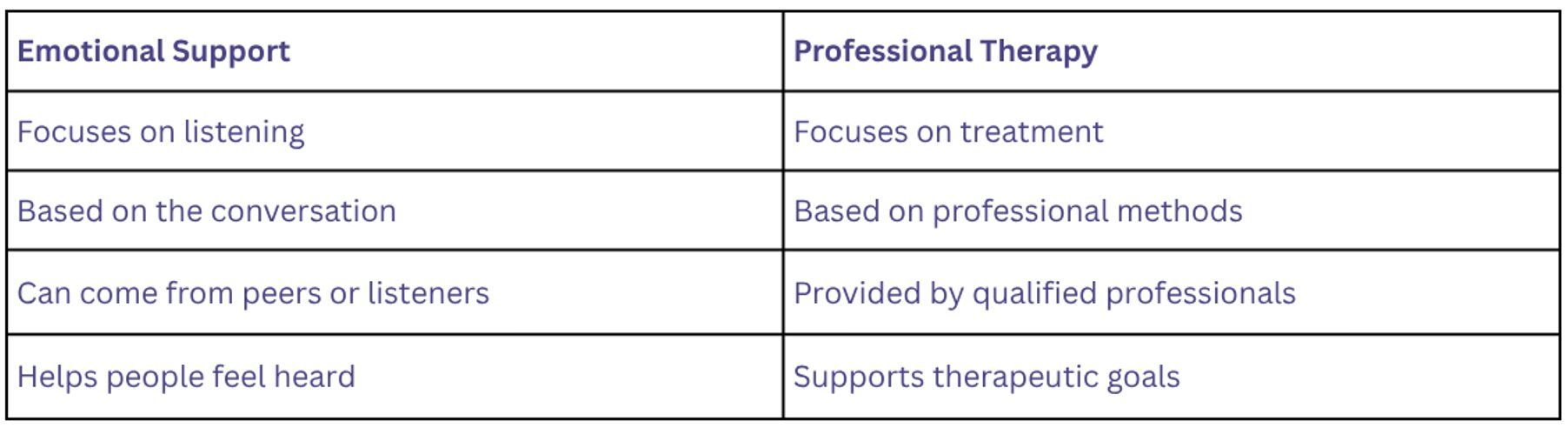
Emotional support is about human connection. It is not a replacement for professional care when specialised help is needed.
Why do I feel like I need emotional support?
If you've been wondering why you feel like you need emotional support, you're probably carrying more emotional weight than you realize. Stress, loneliness, and everyday challenges can quietly build up until simply being heard becomes what you need most.
The answer is that independence and emotional connection are not opposites.
Sometimes carrying everything alone becomes exhausting
Most people can carry a lot. Work pressures, family responsibilities, relationship challenges, uncertainty about the future, and everyday stress can all build up over time.
This often looks like:
- Constant overthinking
- Feeling emotionally tired
- Replaying conversations repeatedly
- Struggling to switch off mentally
- Feeling like you are carrying everything yourself
Eventually, many people realise they do not necessarily need solutions. They need somewhere to put some of that weight down.
Being around people is not the same as feeling understood
One of the most confusing experiences is feeling lonely while surrounded by people.
You may have friends, family, or coworkers around you every day. Yet something still feels missing.
This often happens when:
- Conversations stay surface-level
- You avoid discussing how you really feel
- You feel misunderstood
- You keep important thoughts to yourself
This is why emotional connection matters. Many people are not looking for more interactions. They are looking for more meaningful ones.
Feeling heard can change the experience of a difficult day
Have you ever noticed how one good conversation can shift your entire day? The problem may still exist. Your situation may not have changed. But you no longer feel like you are facing it completely alone.
That feeling of connection is often what people are searching for when they seek emotional support.
How can you tell if you need emotional support?
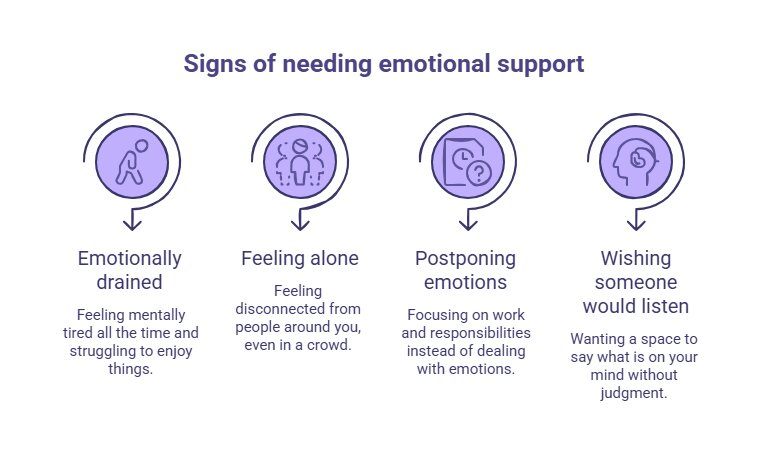
People often look for emotional support when they feel overwhelmed, disconnected, or tired of carrying everything internally. The signs are usually subtle rather than dramatic.
The challenge is that many people do not immediately recognise what they are feeling. Instead, they notice small shifts in their mood, energy, or relationships. If any of the experiences below sound familiar, it may be a sign that you have been carrying more emotional weight than you realise.
1. You feel emotionally drained more often than usual
Have you ever finished a normal day and felt completely exhausted without knowing why?
Sometimes emotional weight builds slowly through everyday experiences.
This might look like:
- Feeling mentally tired all the time
- Struggling to enjoy things you normally like
- Constantly feeling "off."
- Finding it difficult to switch off your thoughts
Many people start looking for support when they become tired of carrying these feelings alone.
2. You feel alone even when people are around
Loneliness is not always about being physically alone.
Sometimes it comes from feeling disconnected from the people around you.
This often sounds like:
- "Nobody really understands."
- "I do not know who to talk to."
- "I feel alone even in a crowd."
- "I keep things to myself."
The issue is often not a lack of people. It is a lack of emotional connection.
3. You keep telling yourself you will deal with it later
Many people postpone their emotions.
They focus on work, responsibilities, and daily life instead.
This often sounds like:
- "I'll deal with it next week."
- "I just need to get through this month."
- "I do not have time for this right now."
The problem is that it keeps moving further away.
4. You keep wishing someone would simply listen
Sometimes, you are not looking for advice or solutions. You just want a space to say what is on your mind without feeling judged or interrupted.
This often sounds like:
- "I just need to get this off my chest."
- "I wish someone understood."
- "I do not need advice right now."
- "I just want someone to listen."
Sometimes, finding the right person to talk to is the hardest part. Platforms like Listennr were created for moments like these, giving people a space to connect with listeners when they simply need someone to hear what they are going through without judgment or pressure.
If these experiences feel familiar, it does not mean something is wrong with you. It may simply be a sign that you have been carrying more than you should have to carry alone.
What are examples of emotional support?
Emotional support doesn't always come in big or dramatic moments. Often, it's found in small acts that help you feel heard, understood, and less alone. While everyone's needs are different, emotional support can look like:
- A friend listening without interrupting or trying to fix the problem.
- A family member checking in after a difficult day.
- A partner sitting with you while you process your emotions.
- A colleague asking how you're coping and genuinely listening to the answer.
- An anonymous listener giving you a safe space to vent without judgement or pressure.
The goal of emotional support isn't to solve every problem. It's to help you feel understood, validated, and connected while you work through what you're experiencing.
Why is it so hard to ask for emotional support?
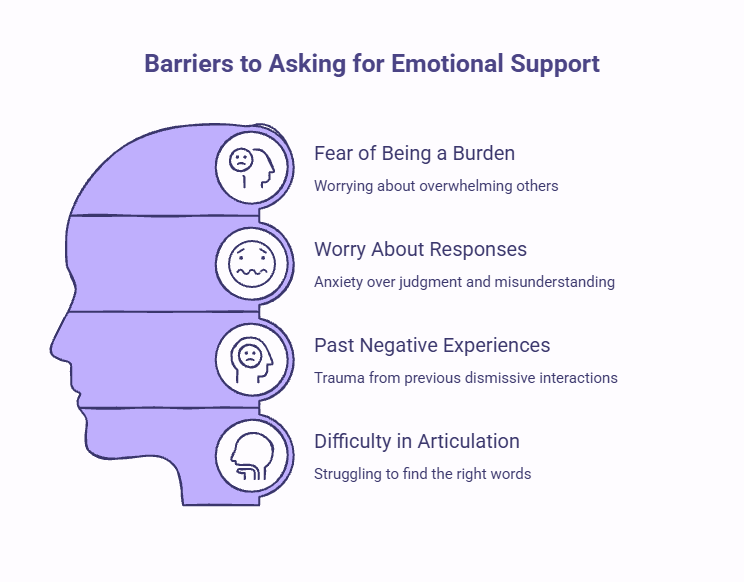
Many people want support long before they ask for it. Fear, uncertainty, and previous experiences often make opening up feel difficult.
If reaching out were easy, far fewer people would struggle in silence. The reality is that asking for support can feel vulnerable, especially when you are unsure how someone might respond. Understanding these barriers can help you realise that your hesitation is more common than you think.
1. You do not want to feel like a burden
You may care deeply about the people around you and still hesitate to reach out.
This often sounds like:
- "They already have enough going on."
- "I should be able to handle this myself."
- "It is not a big deal."
- "Someone else has it worse."
These thoughts can keep people isolated far longer than necessary.
2. You are worried about how people will respond
Opening up involves vulnerability.
Many people worry about:
- Being judged
- Being misunderstood
- Receiving unwanted advice
- Making things awkward
- Feeling dismissed
Even supportive relationships can feel difficult to approach when these worries are present.
3. Previous experiences made opening up harder
Not every conversation goes the way we hope. Some people have shared something personal only to feel ignored, dismissed, or misunderstood. As a result, they become more cautious about opening up again.
4. You do not know where to begin
Sometimes the biggest challenge is finding the words. You know something feels heavy, but explaining it feels impossible. The good news is that you do not need a perfect explanation to start a conversation.
Wanting support and asking for support are often two very different things. Understanding what holds you back is usually the first step towards opening up when you are ready.
What happens when you don't get emotional support?
Going without emotional support for long periods can leave you feeling increasingly isolated, disconnected, or overwhelmed. Without someone to listen, understand what you're experiencing, or offer meaningful connection, everyday stress can become harder to manage.
Everyone experiences a lack of support differently, but you may notice changes in how you connect with others and handle difficult moments.
1. Emotional withdrawal becomes easier
At first, you may pull back because you do not feel supported or understood. Over time, withdrawing from meaningful conversations can start to feel easier than reaching out.
This may look like:
- Avoiding meaningful conversations
- Keeping thoughts private
- Pulling away from people
- Pretending everything is fine
2. Loneliness grows quietly
A lack of emotional support can make you feel lonely even when people are around. Without meaningful connection, you may start feeling like nobody truly understands what you are carrying.
3. Everyday challenges feel heavier
Difficult days can feel harder when you have no one to talk to. Even small frustrations may become more difficult to process when you have little emotional support or connection.
Having someone who listens and understands does not make problems disappear, but it can make difficult experiences feel less isolating and easier to navigate.
How can emotional support help you feel better?
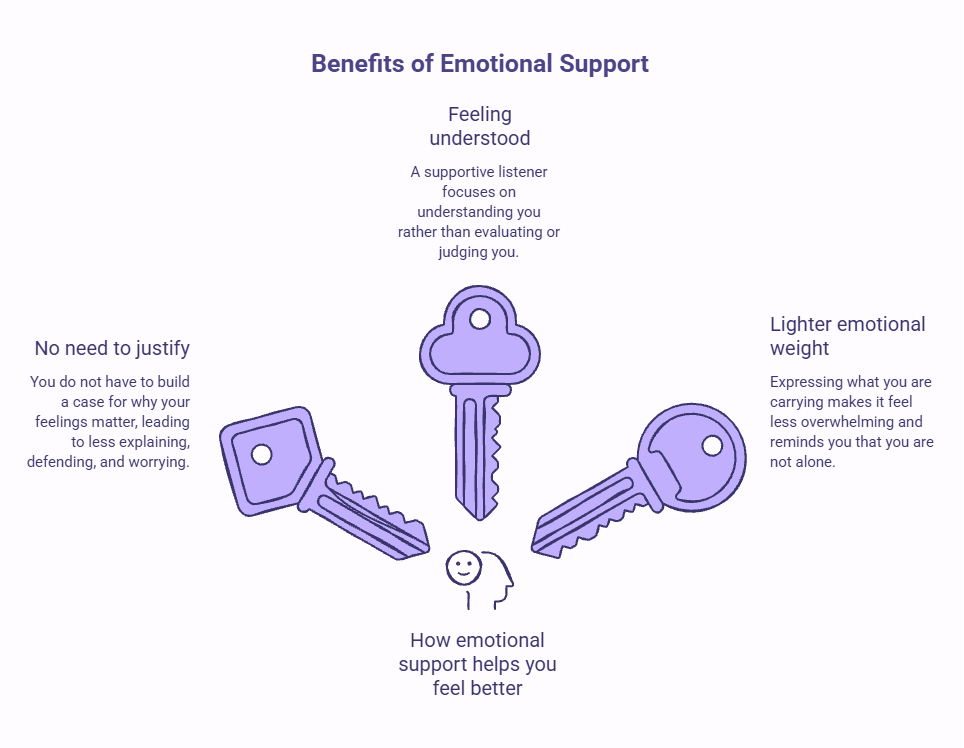
Being genuinely listened to often creates a sense of relief because you no longer feel responsible for carrying everything alone.
Many people receive advice, opinions, and quick responses every day. Being truly listened to is different. It is the experience of feeling understood without having to defend, explain, or justify yourself, and that can make even difficult conversations feel more comfortable.
1. You do not feel the need to justify yourself
When someone listens well, you do not have to build a case for why your feelings matter.
You can simply talk.
This often means:
- Less explaining
- Less defending yourself
- Less worrying about being misunderstood
- More honesty
2. You feel understood instead of judged
A supportive listener is not focused on evaluating you. They are focused on understanding you. That difference can make a conversation feel completely different.
3. The emotional weight feels lighter
The situation may not change. But many people find that expressing what they are carrying makes it feel less overwhelming.
Sometimes being heard is enough to remind you that you are not alone.
Being heard does not always change the situation. Sometimes it simply changes how alone you feel while going through it.
Emotional support vs professional help
While emotional support and professional help can work together, they serve different purposes.
Emotional support:
- Helps you feel heard, understood, and less alone.
- Focuses on listening, empathy, and connection.
- Can come from friends, family, support groups, or trained listeners.
- Helps you process everyday stress, worries, and life challenges.
Professional help:
- Focuses on assessing and treating mental health concerns.
- Provides evidence-based guidance and coping strategies.
- Comes from qualified mental health professionals, such as therapists or counsellors.
- It may be appropriate when emotional distress becomes persistent or begins affecting your daily life.
Many people benefit from both. Emotional support can help you feel understood during difficult times, while professional support offers specialised care when challenges become overwhelming or difficult to manage alone.
What should you do if you have no one to talk to?
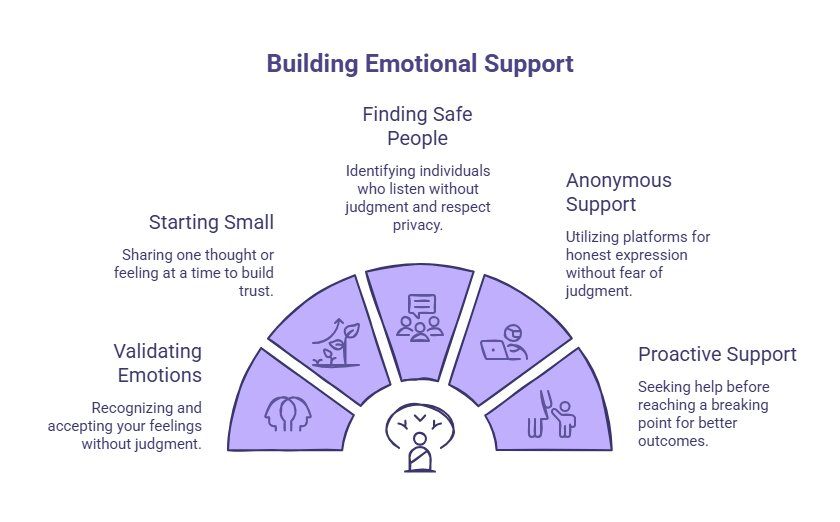
If opening up feels difficult, start small. You do not need to share everything at once to begin feeling supported. Not having the right person to talk to right now does not mean you have to keep carrying everything alone.
There are small, practical steps you can take to express what you are feeling, build emotional connection, and make seeking support feel less overwhelming.
1. Stop minimising what you feel
Many people dismiss their emotions because they believe their problems are not serious enough.
Your feelings do not have to compete with someone else's to matter.
2. Start small instead of sharing everything
You do not need to tell your whole story immediately.
Start with one thought, one feeling, or one difficult day.
Small conversations often lead to deeper ones naturally.
3. Look for emotionally safe people
Not everyone is the right person for every conversation.
Look for people who:
- Listen without judgement
- Respect your privacy
- Avoid making everything about themselves
- Allow you to speak honestly
4. Try anonymous support if opening up feels scary
For some people, talking anonymously feels easier than opening up to someone they know. Without worrying about being judged or affecting existing relationships, it can feel safer to be honest.
This is where platforms like Listennr can help. By offering a space for supportive conversations, it gives people an opportunity to express what they are feeling without the pressure that sometimes comes with opening up to family members or friends.
5. Do not wait until you completely shut down
You do not need to reach a breaking point before seeking support. Many people benefit from talking long before things feel overwhelming.
You do not need to take every step at once. Even one small conversation or moment of honesty can be a meaningful place to start.
Can online emotional support help?
Online emotional support gives people a way to connect and talk openly when traditional conversations feel difficult or inaccessible. For many people, opening up online feels less intimidating than having a face-to-face conversation. The flexibility, privacy, and accessibility of online spaces can make them a useful option for those who want support but are unsure where to begin.
Benefits often include:
- Greater privacy
- Flexible access
- Fewer social expectations
- Opportunities for anonymous conversations
- A comfortable environment for sharing
Different people feel comfortable opening up in different ways. For some, an online conversation can be the first step towards feeling heard and understood.
How can Listennr help when you need emotional support?
Sometimes, knowing you need support is easier than knowing who to talk to.
If opening up to family members, friends, or people you know feels difficult, Listennr provides a space where you can share what is on your mind without feeling judged or pressured. The focus is not on fixing your problems but on helping you feel heard.
With Listennr, you can:
- Connect with supportive listeners
- Talk anonymously if that feels more comfortable
- Share openly without fear of judgment
- Access support when you need someone to listen
You do not have to carry everything alone. Visit Listennr today and start a conversation with someone who is ready to listen.
When should you seek professional help instead of emotional support?
Emotional support and professional support serve different purposes, and in some situations, people may benefit from both. Talking to a trusted listener can help you feel heard and less alone, but there are times when additional support from a qualified mental health professional may be more appropriate.
You may want to consider professional support if:
- Emotional distress feels intense or difficult to manage
- Your feelings are affecting work, relationships, or daily responsibilities
- You need specialised guidance for a specific concern
- You are experiencing a crisis or feel unsafe
Seeking professional help is not a sign that you have failed to cope on your own. It is simply another form of support that may be helpful when challenges become difficult to navigate alone. Emotional support can provide connection and understanding, while professional care can offer expertise tailored to your situation.
You Don't Have to Carry It Alone
If you have been thinking, "I need emotional support," take that feeling seriously. You do not need a perfect explanation. You do not need a major crisis. And you do not need to wait until everything feels overwhelming.
Start small. Talk to someone you trust. Explore online emotional support options. Give yourself permission to say what has been sitting quietly in the background. Being heard may not solve every problem, but it can remind you that you do not have to face those problems alone.
Frequently asked questions
Is it normal to feel like I need emotional support even when nothing major has happened?
Yes. Many people look for social support during everyday stress, uncertainty, or life changes. You do not need a major event or crisis to seek support. Even smaller life challenges can affect your emotional well-being and leave you wanting someone to talk to.
Why do I feel better after talking to someone?
Talking can help you feel less alone with what you are experiencing. Supportive conversations often strengthen social connections, provide perspective during difficult times, and create a sense of understanding that supports overall emotional health and comfort.
Can online emotional support really help?
For many people, yes. Online emotional support can feel more accessible, especially during a tough time when opening up face-to-face feels difficult. Some people prefer an app, online community, or support group because it offers flexibility and privacy.
What if I do not know how to explain my feelings?
That is very common, especially the first time you open up. You do not need perfect words. Start by describing what has been on your mind recently or how your day has been feeling emotionally. Small conversations often become easier over time.
Is emotional support the same as therapy?
No. Emotional support focuses on listening, understanding, and compassion, while therapy is a professional service provided by qualified practitioners. Emotional support is not medical treatment, cognitive behavioral therapy, or a replacement for professional mental health care when specialised support is needed.
What should I do if I have nobody to talk to?
Start small. You might explore different types of support, such as trusted listeners, online communities, a support group, or platforms that focus on conversation and connection. Practising mindfulness, setting healthy boundaries, or reaching out through an app can also help.
Can emotional support come from people other than family and friends?
Absolutely. While many people turn to family members, emotional support can also come from support groups, online communities, peers, mentors, or trained listeners. The most important thing is finding a type of support that feels safe and comfortable for you.
Can emotional support help during major life challenges?
Many people seek support during life challenges such as relationship changes, work stress, grief, or uncertainty about the future. While emotional support does not remove the challenge itself, it can make difficult times feel less isolating and easier to talk through.