%20(1).jpg)
Listen to Understand: Are You Really Listening?

Key highlights
- Listening to understand improves effective communication and reduces misunderstandings.
- Focusing on the speaker's message helps people feel genuinely heard.
- Noticing emotions and nonverbal cues leads to deeper understanding.
- An open mind helps you navigate disagreement and difficult conversations.
- Healthy boundaries prevent listener fatigue and emotional exhaustion.
- Thoughtful listening strengthens trust in personal relationships.
- Build stronger listening habits and meaningful conversations with Listennr.
Have you ever had someone open up to you about something important, only to realise later that they still felt misunderstood? It can be frustrating to genuinely want to support someone yet struggle to make them feel truly heard. Whether it is a friend sharing a personal challenge, a partner expressing frustration, or a colleague discussing a concern, good intentions alone do not always create meaningful conversations.
One of the biggest reasons for this is that many people listen with the goal of replying, reassuring, or solving a problem rather than understanding what the other person is actually experiencing. When listeners focus on their response too quickly, conversations can leave people feeling unheard, dismissed, or reluctant to open up further, even when support is being offered.
If you've ever wondered how to listen to understand instead of simply waiting for your turn to speak, this guide will help. You'll learn why people often feel unheard, how to recognise common listening habits that create distance, and practical ways to help others feel valued, understood, and supported in everyday conversations.
Why do so many conversations leave people feeling unheard?
Many people assume that listening means staying quiet while someone else speaks. However, feeling heard is about more than being given a chance to talk. People feel heard when they believe someone has genuinely understood what they are trying to communicate. When that understanding is missing, even well-intentioned conversations can leave them feeling frustrated, dismissed, or disconnected.
- Listeners focus on the problem instead of the emotions behind it.
- They think about their response before the speaker has finished talking.
- They are physically present but mentally distracted.
- They make assumptions before understanding the full situation.
- They interrupt, rush, or finish the speaker's sentences.
- They offer advice before fully understanding the person's experience.
- They shift the conversation towards their own experiences too quickly.
People feel heard when listeners focus on understanding rather than responding. Small changes in the way you listen can strengthen trust, encourage openness, and help create more meaningful conversations in both personal and professional relationships.
What changes when you listen to understand instead of trying to fix?
Have you ever noticed how some people open up to you once and never do it again? In many cases, it is not because they did not trust you. It is because they did not feel understood. When people feel judged, corrected, analysed, or rushed towards a solution, they often stop sharing what they are really thinking. This is why learning to listen to understand is one of the most valuable skills a listener can develop.
When you stop trying to fix and start trying to understand, several important things happen:
- People become more honest: They are more likely to share the full story rather than only the parts they think will be accepted.
- Conversations go deeper: Instead of discussing surface-level problems, you begin to understand the emotions and concerns underneath them.
- Defensiveness decreases: People feel less pressure to justify their feelings when they know they are being listened to.
- Trust builds naturally: Being understood often creates stronger trust than receiving advice.
- People feel less alone: Sometimes knowing that someone genuinely understands their experience can be more comforting than finding an immediate solution.
- You avoid solving the wrong problem: Understanding first helps you identify what the person actually needs instead of assuming what would help.
- Advice becomes more effective: When people feel heard, they are often more open to guidance and suggestions later.
For listeners, this matters because understanding is often what determines whether a conversation strengthens or weakens a relationship. People may not remember every word you say, but they are far more likely to remember whether they felt understood when speaking to you.
Are you listening to understand or listening to respond?
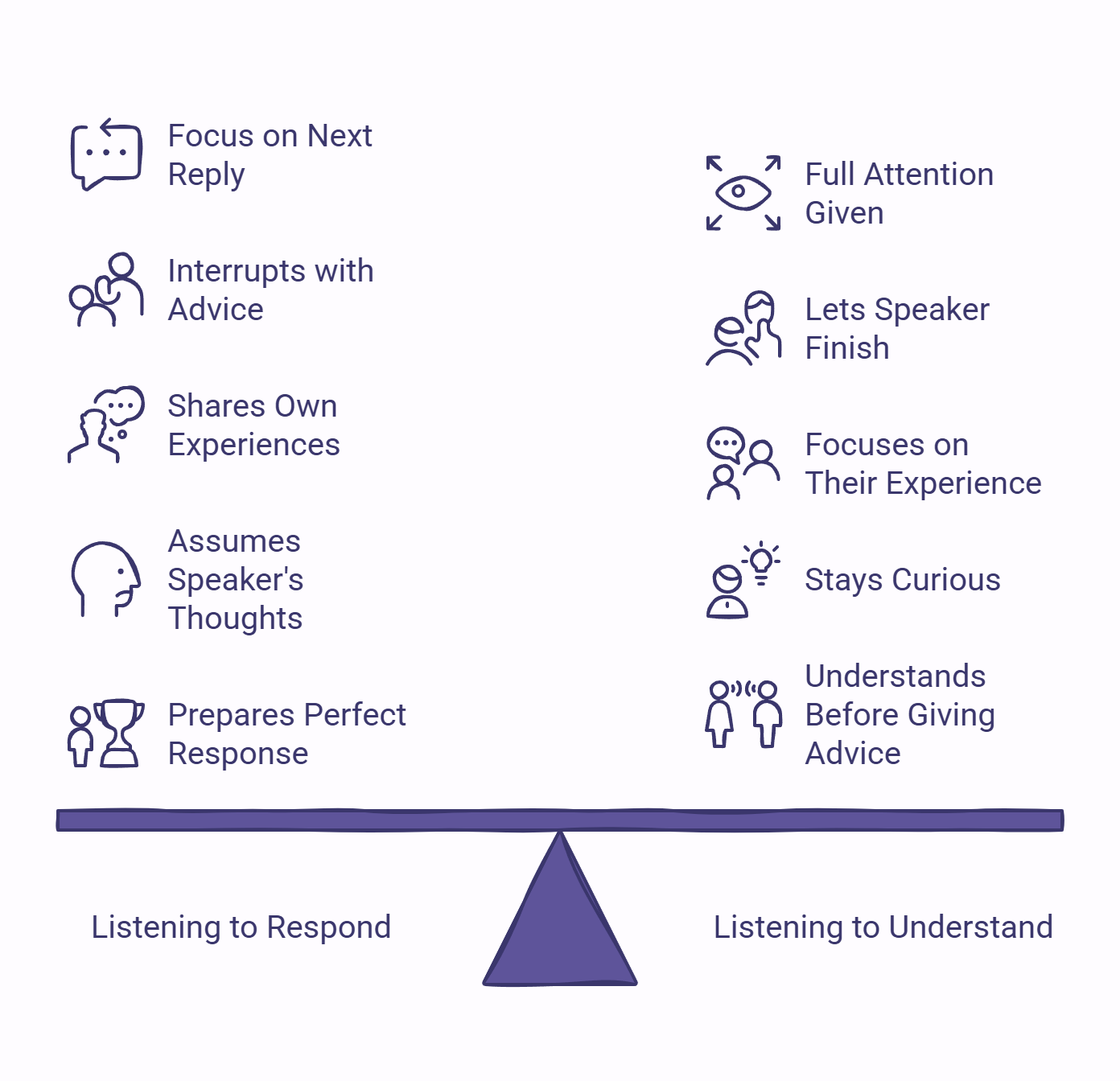
The difference between listening to understand and listening to respond is not always obvious. Many people assume they are doing the former when they are actually doing the latter. Paying attention to your listening habits can help you recognise whether your focus is on understanding the speaker or preparing your next response.
Signs you're listening to respond
You may be listening to respond if you:
- Start planning your reply before the other person has finished speaking.
- Interrupt with advice, suggestions, or solutions.
- Look for opportunities to share your own experiences.
- Assume you already know what the speaker is going to say.
- Focus more on what you want to communicate than what they are trying to express.
These habits can prevent you from fully understanding the emotions and meaning behind someone's words.
Signs you're listening to understand
At its core, listening is the ability to understand, not simply hear words or wait for an opportunity to speak. You are more likely to be listening to understand if you:
- Give the speaker your full attention.
- Let them finish without interrupting.
- Focus on their experience rather than your own.
- Stay curious instead of making assumptions.
- Take time to understand before offering advice or opinions.
Listening to understand requires patience and intention. The goal is not to prepare the perfect response, but to make the other person feel genuinely understood.
Why do most people not listen with the intent to understand?
Most people do not listen with the intent to understand because their attention is often divided. While someone is speaking, they may be thinking about what to say next, comparing the situation to their own experiences, or looking for a solution. Others feel uncomfortable with silence or difficult emotions and rush to offer advice. As a result, they focus on responding rather than fully understanding what the speaker is trying to communicate.
This is why the principle "don't listen to respond, listen to understand" remains one of the most valuable communication lessons for listeners.
See how Listennr works and discover what meaningful listening looks like in practice.
What should you pay attention to when someone is speaking?

Many listeners focus primarily on the words being spoken. However, understanding someone often requires paying attention to much more than the information they share. If your goal is to listen to understand, it helps to look beyond the surface of the conversation and focus on what the person is really trying to communicate.
1. How are they feeling?
People often talk about situations when they are actually trying to express how those situations made them feel. Pay attention to emotions such as frustration, disappointment, anxiety, excitement, or relief, as they often reveal what matters most to the speaker.
2. What seems most important to them?
When someone repeatedly mentions the same concern, person, or situation, it is usually a sign that it carries particular importance for them. These recurring themes can provide valuable insight into what they are truly trying to communicate.
3. Are they leaving something unsaid?
Not everyone expresses their thoughts and feelings openly. Hesitations, pauses, changes in tone, or avoiding certain topics can sometimes reveal as much as the words themselves. Paying attention to these cues can help you better understand their perspective.
4. What do they need from this conversation?
Many conversations are about more than the issue being discussed. Someone may be seeking reassurance, support, clarity, validation, or simply a chance to be heard. Understanding this need can help you respond more effectively.
5. What are they hoping you will understand?
Instead of focusing only on the details, ask yourself: What does this experience mean to this person? Understanding the significance of the situation from their perspective often leads to deeper and more meaningful conversations.
The most effective listeners pay attention to more than words. By noticing emotions, recurring concerns, unspoken cues, underlying needs, and personal meaning, you can develop a deeper understanding of what someone is truly trying to communicate.
What do you do when you do not understand?

You do not have to fully relate to someone's experience to make them feel heard. In fact, some of the most supportive listeners are not the ones who have all the answers. They are the ones who stay curious when something does not make sense.
1. Be honest that you do not fully understand
Avoid pretending that you know exactly how someone feels. A simple response such as "I haven't experienced that myself, but I'd like to understand" shows openness and encourages them to share feelings more fully.
2. Ask them to help you see it from their perspective
Instead of trying to interpret their experience yourself, invite them to explain it in their own words.
Questions like:
- What has that been like for you?
- What part of this has been the hardest?
- What do you wish other people understood about it?
can provide far more insight than jumping to conclusions.
3. Focus on the feeling, not the situation
You may not understand the exact circumstances, but you can often understand emotions such as disappointment, fear, frustration, loneliness, or uncertainty. Connecting with the feeling behind the story helps create understanding even when the situation itself feels unfamiliar.
4. Resist the urge to compare experiences
When something feels unfamiliar, many listeners try to relate it to their own experiences. While well-intentioned, comparisons can shift the focus away from the speaker. Let their experience stand on its own before bringing your own into the conversation.
5. Repeat back what you think you heard
A simple summary such as "It sounds like you're feeling frustrated because..." gives the other person a chance to confirm, clarify, or correct your understanding. This often prevents misunderstandings and shows that you are making an effort to understand.
6. Be comfortable not having all the answers
Sometimes understanding takes time. You do not need the perfect response or complete clarity immediately. People often appreciate genuine curiosity and patience more than quick answers.
When you do not understand, your goal is not to become an expert on someone's experience. Your goal is to listen to understand and show a genuine willingness to learn about their perspective. That effort alone can make a significant difference in how supported and valued they feel.
How do you stay supportive when you disagree?
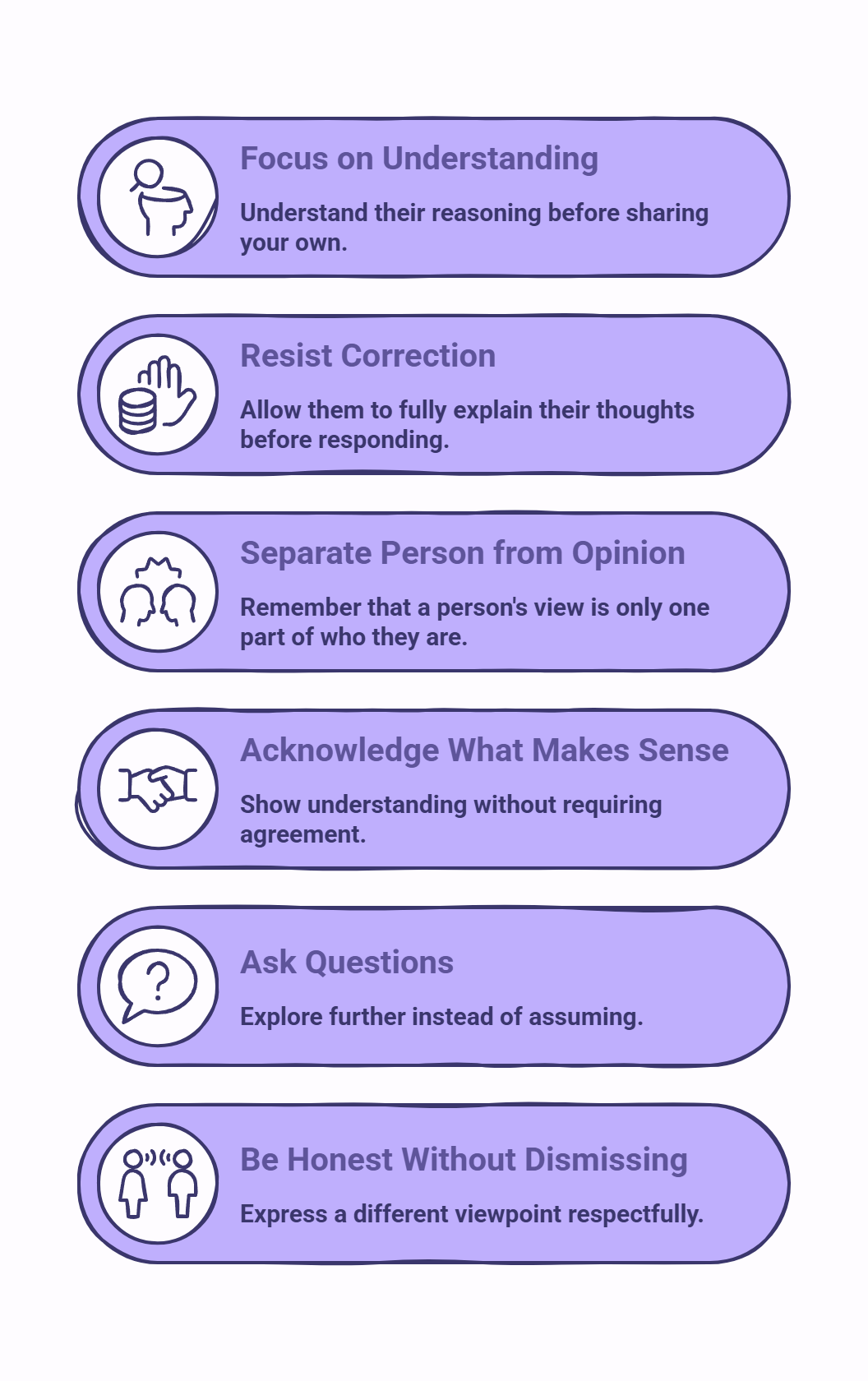
One of the biggest challenges for listeners is staying supportive when they strongly disagree with what someone is saying. However, effective listening does not require agreement. The goal is to listen to understand, not to respond, creating space for the other person's perspective before sharing your own.
1. Focus on understanding their reasoning first
When you disagree, your instinct may be to explain why they are wrong. Instead, try to understand how they arrived at that conclusion. Ask yourself: What experiences, concerns, or beliefs might be influencing their perspective? Understanding the reasoning behind a viewpoint often makes conversations more productive.
2. Resist the urge to correct them immediately
Many listeners start building a counterargument while the other person is still speaking. This shifts your attention away from understanding. Before offering your perspective, allow the person to fully explain their thoughts, even if you already disagree.
3. Separate the person from the opinion
Disagreement becomes easier when you remember that a person's view is only one part of who they are. Challenging an idea does not require dismissing, judging, or invalidating the individual sharing it.
4. Acknowledge what makes sense
You do not have to agree with everything to recognise part of someone's experience. Statements such as "I can see why you feel that way" or "I understand why that was frustrating for you" show understanding without requiring agreement.
5. Ask questions before sharing your perspective
If something does not make sense to you, explore it further instead of assuming. Questions such as "What led you to that conclusion?" or "Can you help me understand that better?" often reveal information you may have missed.
6. Be honest without becoming dismissive
There may be times when you need to express a different viewpoint. When you do, avoid language that shuts the conversation down. Instead of saying "You're wrong", try "I see it differently because..." This keeps the conversation respectful while allowing room for both perspectives.
The goal of listening is not to agree with everything someone says. The goal is to understand their perspective well enough that they feel heard. When you can stay curious, ask thoughtful questions, and avoid rushing into debate, disagreement becomes an opportunity for understanding rather than conflict.
Discover real stories from people who found support through Listennr.
How do you handle repeated venting without becoming frustrated?
Listening to the same concerns repeatedly can be challenging, especially when the conversation never seems to move forward. The goal is not to stop being supportive, but to avoid becoming emotionally drained or stuck in the same cycle.
- Ask what has changed since the last conversation instead of revisiting the entire situation.
- Ask, "What's feeling most difficult about this today?"
- Reflect recurring themes without judging them.
- Ask whether they want understanding, advice, or simply a space to vent.
- Avoid taking responsibility for solving a problem they are not ready to address.
- Pause the conversation when you notice you're listening out of obligation rather than attention.
- Ask what they have already tried before suggesting new solutions.
- Notice when the conversation keeps repeating the same details without adding new insights or feelings.
Being supportive does not mean absorbing the same frustrations indefinitely. To listen to understand, effective listeners balance empathy with healthy boundaries. This allows them to remain present and supportive while encouraging more constructive conversations and protecting their own emotional well-being.
How can you make someone feel heard through text or online chats?
Listening through text or online chats comes with challenges that do not exist in face-to-face conversations. Without tone, facial expressions, or body language, it is easier to misinterpret messages or miss emotional cues. Being intentional about how you read and respond can help others feel genuinely understood.
Listening without tone or body language
When communicating through text, you only see the words someone chooses to share. You cannot rely on facial expressions, pauses, voice changes, or body language to provide additional context. This makes it important to avoid assumptions and focus on understanding before interpreting. If something feels unclear, it is often better to seek clarification than assume what the person is feeling or intending.
Showing understanding through written responses
In digital conversations, people cannot see your facial expressions, hear your tone, or notice your attention. As a result, understanding needs to be communicated more deliberately through your words.
Some practical ways to do this include:
- Refer to specific details they mentioned instead of sending generic replies. This shows you are paying attention to their actual experience.
- Acknowledge the emotion before discussing the situation, such as recognising that something sounds frustrating, disappointing, or overwhelming.
- Reflect back on what you understood in your own words to confirm you are interpreting the message correctly.
- Give them space to elaborate rather than filling the conversation with advice or solutions.
- Avoid one-word responses such as "okay", "sure", or "understood", which can feel dismissive in emotional conversations.
- Respond to what matters most to them, not just the final sentence they sent.
Small actions like these can make a significant difference in helping someone feel understood through text, especially when non-verbal cues are absent.
Text conversations require a different approach to listening. By paying closer attention to context, avoiding assumptions, and responding thoughtfully, you can help people feel understood even when communication happens entirely through a screen.
How to listen without becoming emotionally exhausted?
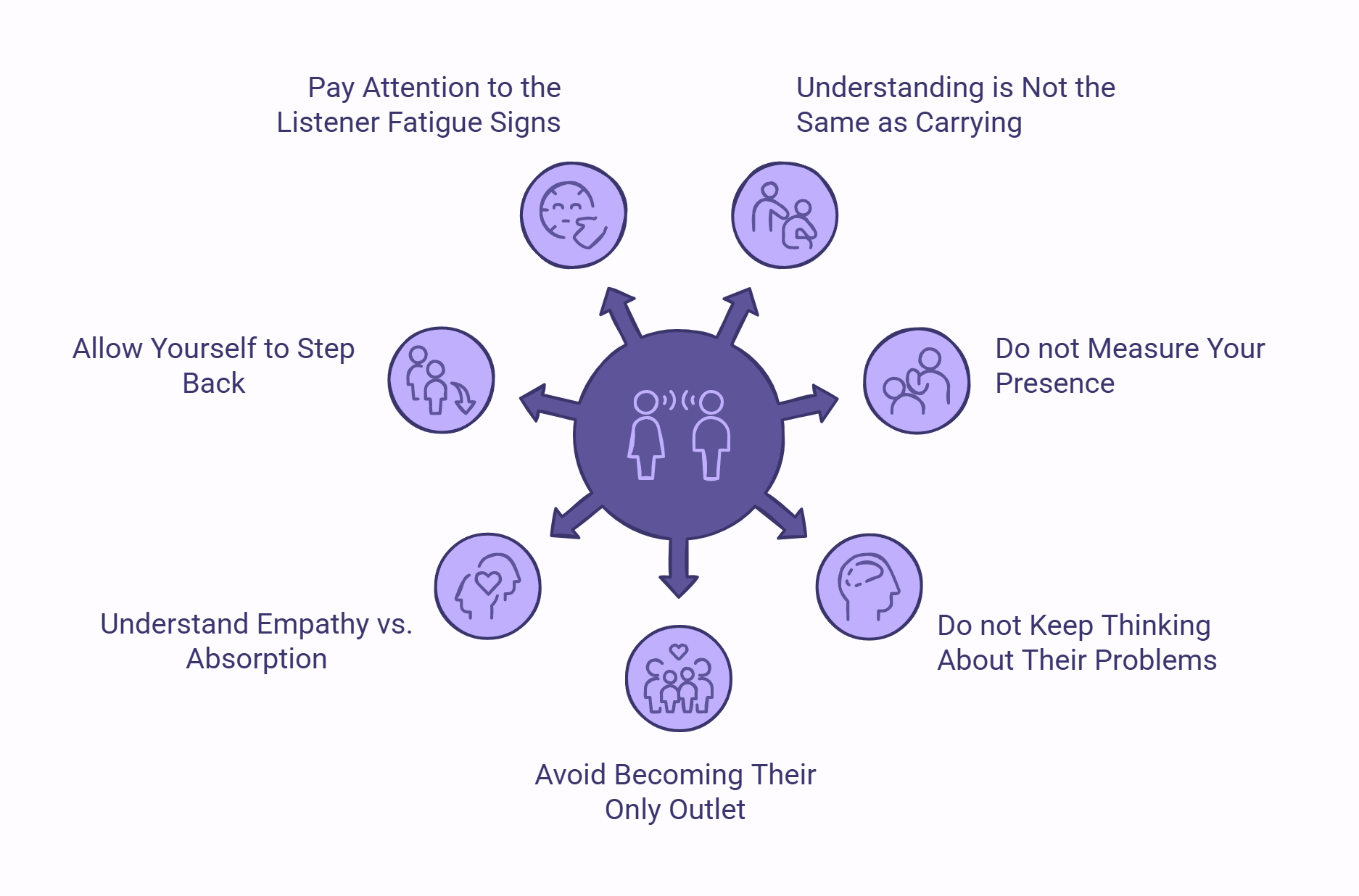
Being a good listener does not mean absorbing every emotion someone shares with you. To listen to understand, focus on offering attention and empathy rather than taking responsibility for someone's struggles. Healthy boundaries help you stay supportive while protecting your own emotional well-being and preventing burnout over time.
1. Remember that understanding is not the same as carrying
You can acknowledge someone's pain without making it your responsibility to fix or resolve it. Your role is to listen and understand, not to take ownership of their challenges.
2. Stop measuring your value by how much you help
Many listeners feel frustrated when conversations do not lead to progress. However, being supportive is not always about creating change. Sometimes your presence is valuable even when the situation remains the same.
3. Notice when you are thinking about their problems outside the conversation
A useful check is to ask yourself: "Am I listening to this person, or am I mentally carrying their situation with me?" If the conversation continues to occupy your thoughts long afterwards, it may be a sign that you are becoming emotionally overinvested.
4. Avoid becoming someone's only outlet
When one person relies exclusively on you for emotional support, the relationship can become unbalanced. Encourage a wider support system rather than positioning yourself as their sole source of understanding.
5. Recognise the difference between empathy and emotional absorption
Empathy allows you to understand what someone is feeling. Emotional absorption causes you to experience and carry those emotions as though they were your own. The first is supportive. The second is exhausting.
6. Give yourself permission to step back when needed
Being supportive does not require unlimited availability. If you are mentally drained, distracted, or unable to give someone your full attention, it is okay to continue the conversation at another time.
7. Pay attention to signs of listener fatigue
You may need to reset your boundaries if you find yourself:
- Feeling irritated before conversations begin.
- Avoiding calls or messages.
- Feeling responsible for someone else's choices.
- Struggling to switch off after listening.
These signs often indicate that you are carrying more emotional weight than you need to.
The most effective listeners are not the ones who absorb every emotion. They are the ones who remain present, compassionate, and understanding without losing themselves in someone else's struggles. Understanding creates connection, but healthy boundaries make that support sustainable.
Looking to become a better listener?
Listening to understand is not always easy. It takes patience, self-awareness, and practice to move beyond responding, advising, or solving problems. The more you understand how people want to be heard, the more meaningful and supportive your conversations become.
At Listennr, we believe that great listening can have a lasting impact on relationships, emotional well-being, and everyday interactions. By learning what makes people feel understood and applying these principles in real conversations, you can become a more empathetic, attentive, and effective listener.
Ready to improve the way you listen?
Explore Listennr to learn more about meaningful listening and discover how understanding can transform the conversations you have every day.
The conversations people remember start with understanding
The ability to listen to understand can transform the quality of your conversations and relationships. While it may be tempting to focus on responding, advising, or proving a point, genuine understanding often has a far greater impact. People are more likely to trust, open up to, and connect with those who make an effort to understand their perspective.
The next time someone shares something important, pause before responding. Choose to listen to understand rather than simply react. That small shift can help people feel valued, respected, and genuinely heard.
Frequently asked questions
How can listening to understand affect the outcome of a conversation?
Listening to understand improves communication skills by helping you focus on the speaker's message rather than your own response. This reduces misunderstandings, creates trust, and often leads to clearer next steps for everyone involved.
Are there exercises to improve listening to understand skills?
Yes. Try paraphrasing what you heard, waiting a few seconds before replying, and asking one clarifying question. These active listening skills require conscious effort but can strengthen understanding and improve everyday conversations.
What are the signs of someone listening to understand?
A good active listener stays present, avoids interruptions, notices tone of voice, and asks thoughtful questions. Their responses reflect what was said rather than immediately shifting the focus towards their own thoughts or opinions.
How can I practice listening to understand in everyday conversations?
Start by giving your full attention, avoiding interruptions, and asking follow-up questions. Listening to others with understanding and empathy becomes easier when you focus on their perspective instead of preparing your next response.
What mistakes do people make when they listen only to reply?
Many people interrupt, make assumptions, or focus on their response instead of the speaker's message. To avoid this, listen to understand, not to reply, and remember that meaningful conversations require the willingness to listen and the patience to understand.