
How to Make Someone Feel Heard: Are You Truly Listening?

Key highlights
- Feeling heard often matters more than receiving advice or solutions.
- Active listening helps people feel emotionally safe enough to open up honestly.
- Many people repeat themselves because they still do not feel understood.
- Validation and curiosity usually work better than reassurance or fixing.
- Feeling seen and heard can reduce emotional isolation and strengthen trust.
- A good listener focuses on understanding before responding.
- Listennr creates safe spaces where people can feel heard, supported, and less alone through human conversation.
- Sometimes, being the reason someone feels seen, heard, and supported changes far more than you realise.
There is a moment many listeners recognise immediately.
Someone pauses halfway through a sentence and says, "I don't know why I'm feeling like this." They apologise for rambling, laugh awkwardly, or suddenly change the subject altogether. In those moments, many listeners feel pressure to say something useful, offer advice, or somehow make the situation better.
The challenge is that this is often not what the other person needs most.
Many people are not looking for solutions first. They are looking for understanding, emotional safety, and reassurance that what they are feeling makes sense to another human being. They want to know they are not overreacting, being dramatic, or becoming a burden to somebody else.
Learning how to make someone feel heard is one of the most valuable skills a listener can develop. This guide explores why feeling heard matters so much, what causes people to feel misunderstood even in conversations, and how listeners can create the kind of emotional safety that helps people feel less alone.
Why does feeling heard matter so much?
Most people underestimate the importance of feeling heard until they experience the opposite. Feeling unheard often creates frustration, loneliness, and emotional distance, even when conversations are happening regularly. A person can spend hours talking and still leave feeling as though nobody actually understood what they were trying to say.
Research published by Harvard Business Review found that people often judge difficult conversations less by the quality of the advice they receive and more by whether they felt genuinely understood during the interaction.
That makes sense because emotional pain is often connected to isolation rather than uncertainty.
When people experience feeling heard, several things happen naturally:
- They become less defensive.
- They feel safer expressing difficult emotions.
- They gain more clarity around their own thoughts.
- They become more open to support and perspective.
- They feel less alone in what they are carrying.
This is one reason emotional support plays such an important role in overall mental health and well-being.
What does it actually mean to make someone feel heard?
Making someone feel heard is not the same as agreeing with them. It also does not mean having the perfect response ready or knowing exactly what to say next. Instead, it means creating the experience that their thoughts, feelings, and experiences matter enough to deserve your attention without interruption, judgment, or urgency.
What helps a person feel understood is often surprisingly simple:
- Feeling listened to without distractions.
- Feeling safe enough to be vulnerable.
- Feeling that emotions are being taken seriously.
- Feeling curiosity rather than criticism.
- Feeling accepted even during uncertainty or disagreement.
A conversation can include different opinions and still leave somebody feeling deeply understood.
Likewise, a conversation can include complete agreement and still leave somebody feeling invisible.
Why do people often feel unheard even when others are listening?
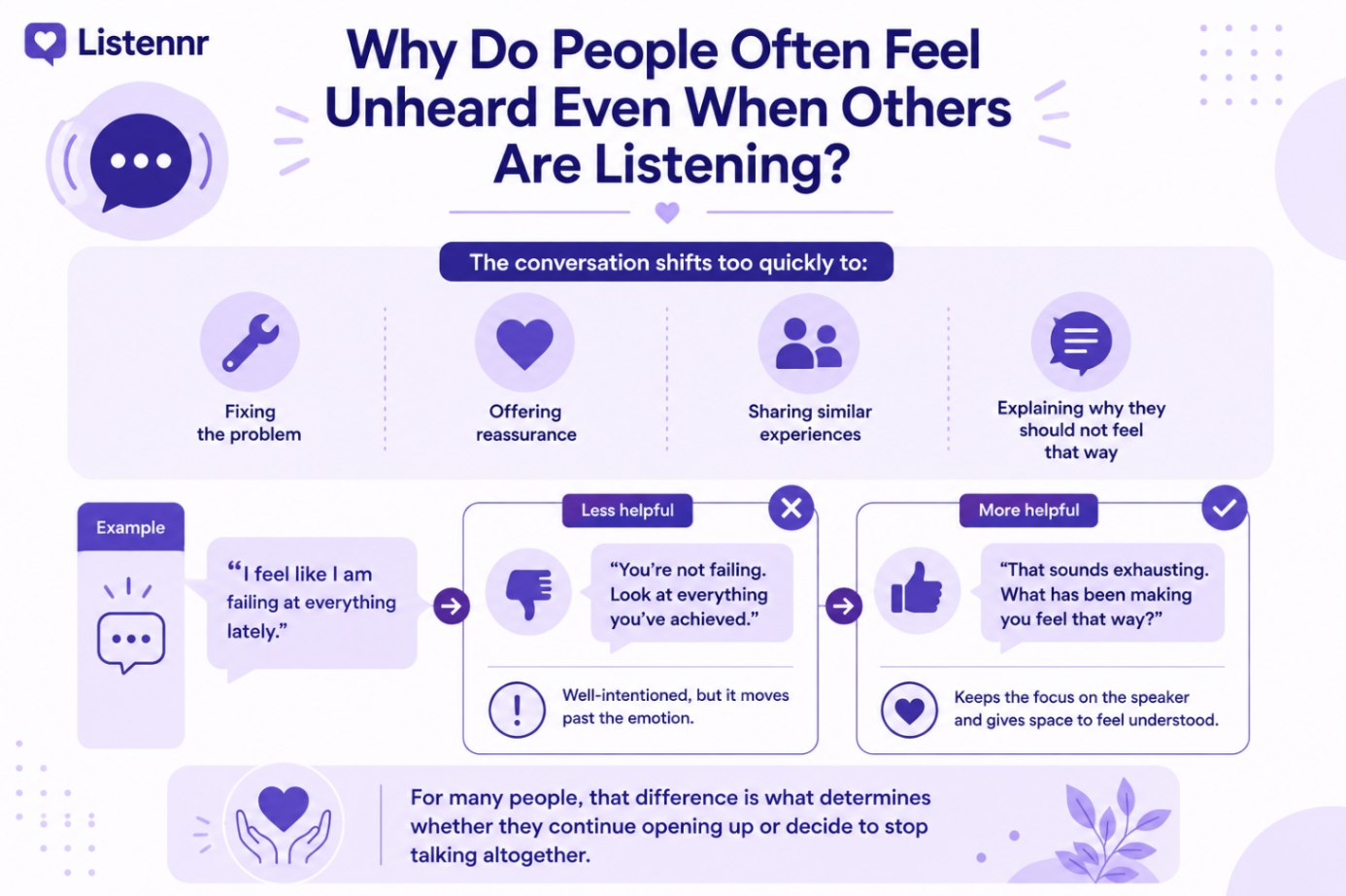
People rarely feel unheard because nobody was listening. More often, they feel unheard because the conversation moved away from what they were trying to say before they had fully said it.
This usually happens with good intentions. Listeners want to help, reassure, or solve the problem quickly. But support can sometimes arrive before understanding does. People are more likely to feel unheard when the response immediately shifts to:
- Fixing the problem.
- Offering reassurance.
- Sharing similar experiences.
- Explaining why they should not feel that way.
Imagine someone saying:
"I feel like I am failing at everything lately."
A response such as:
"You're not failing. Look at everything you've achieved." comes from kindness, but it can unintentionally move past the emotion underneath the statement.
A response like:
"That sounds exhausting. What has been making you feel that way?" keeps the focus on the speaker and gives them space to feel understood before moving towards solutions. For many people, that difference is what determines whether they continue opening up or decide to stop talking altogether.
Why do people repeat themselves when they do not feel understood?
Many listeners become frustrated when conversations keep circling back to the same topic. Usually, this is not because the person wants attention. It is because the emotional task of the conversation has not yet been completed.
People often repeat themselves because they are still searching for understanding. This is why people say things such as:
- "That's not what I meant."
- "What I'm trying to explain is..."
- "No, you're missing the point."
Interestingly, this has very little to do with facts or even false memories. More often, it reflects an emotional need that still feels unfinished. Once people feel genuinely understood, repetition often decreases naturally because the nervous system no longer feels responsible for defending or explaining itself.
What are the biggest mistakes listeners make?
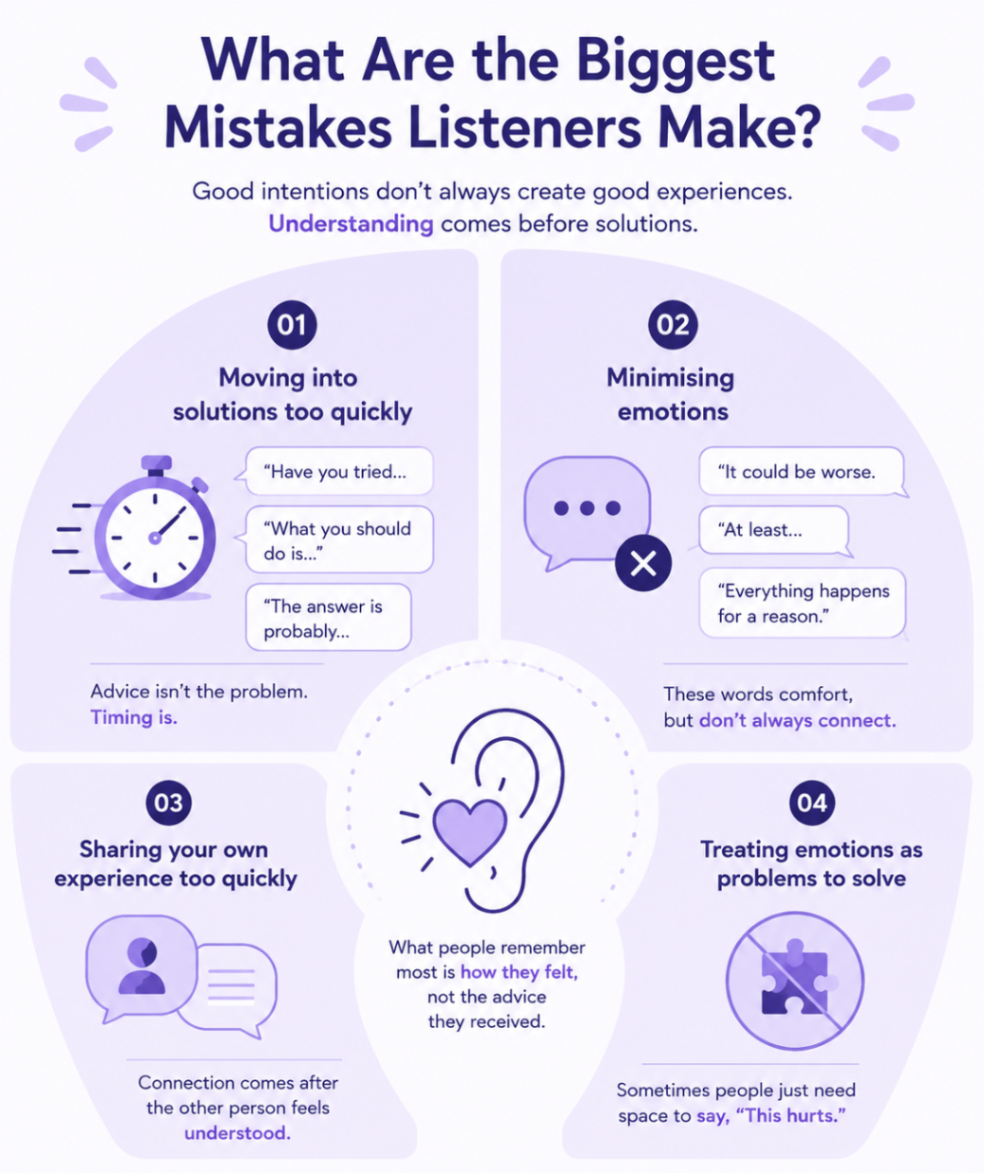
Most listening mistakes come from kindness rather than carelessness. When someone is struggling, the instinct is often to help quickly. The problem is that understanding usually needs to come before solutions.
1. Moving into solutions too quickly
Many listeners assume helping means solving. That often sounds like:
- "Have you tried..."
- "What you should do is..."
- "The answer is probably..."
Advice is not the problem. Timing is. Most people need to feel understood before they are ready for solutions.
2. Minimising emotions
Responses such as:
- "It could be worse."
- "At least..."
- "Everything happens for a reason."
They are usually meant to comfort.
Instead, they can make people feel as though their emotions are being measured rather than heard.
3. Sharing your own experience too quickly
Personal stories can create connection, but only after the other person feels understood. There is a difference between:
"I understand that feeling."
and immediately turning the conversation towards your own experience.
4. Treating emotions as problems to solve
Sometimes people are not looking for answers. They simply want space to say:
"This hurts."
without feeling pressure to fix it or move past it.
Understanding this changes the role of the listener completely. Often, what people remember most is not the advice they received but how they felt during the conversation.
Talking to someone with anxiety can feel intimidating when you are worried about saying the wrong thing. Learn how to offer support, listen with empathy, and create conversations that feel safe rather than overwhelming.
How can you make someone feel heard in practical ways?
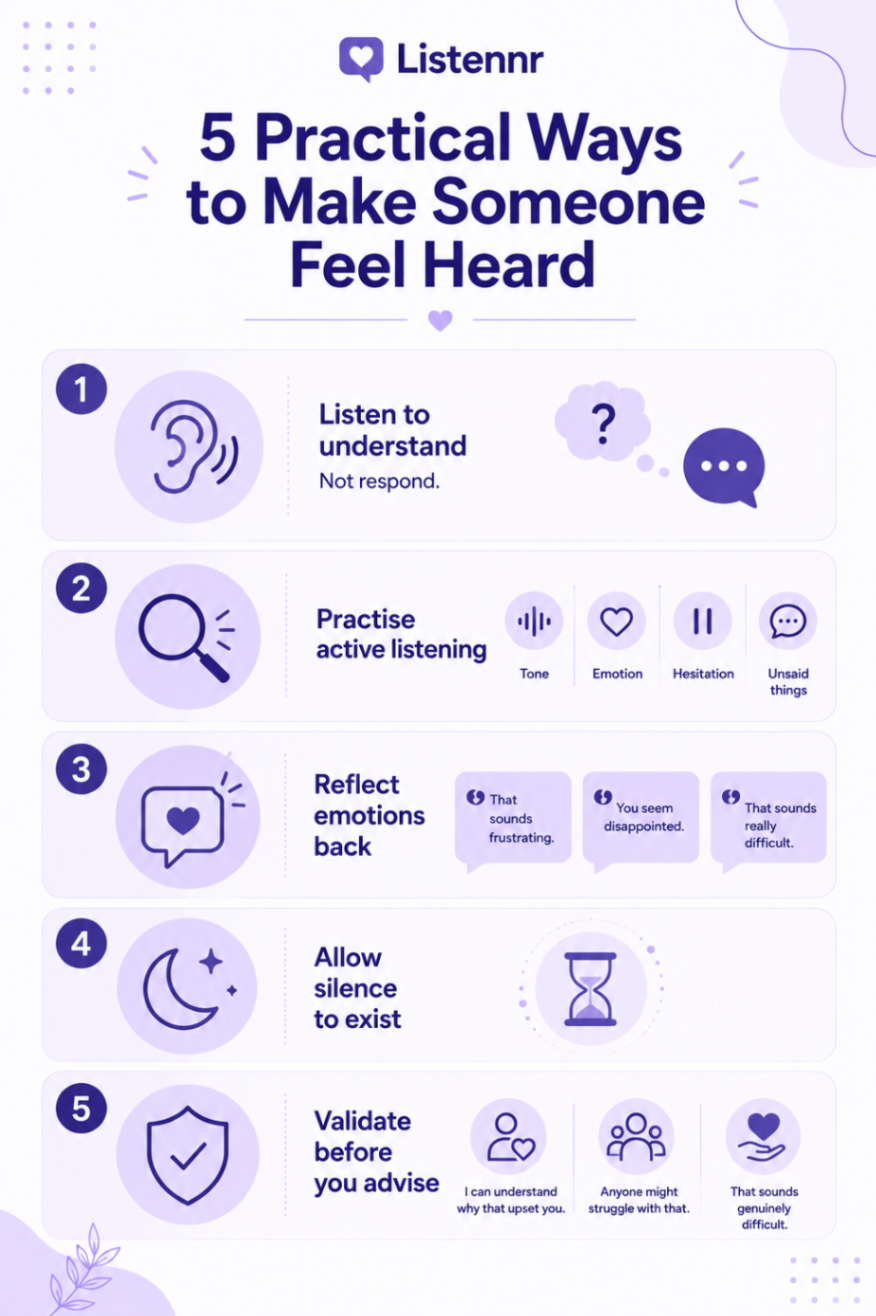
Making someone feel heard rarely requires perfect words. Small changes in how you listen can make a person feel seen, heard, and supported in ways they remember long after the conversation ends.
1. Listen to understand rather than respond
Before replying, ask yourself:
"Am I trying to understand this person or prepare my response?"
That small shift changes conversations immediately.
2. Practise active listening
Active listening means paying attention to both words and emotions.
A good listener notices:
- Tone.
- Emotion.
- Hesitation.
- What may be left unsaid.
3. Reflect emotions back
Simple responses often work best:
- "That sounds frustrating."
- "You seem disappointed."
- "That sounds really difficult."
These responses help the other person feel heard without assuming you fully understand their experience.
4. Allow silence to exist
Silence often feels uncomfortable for listeners but useful for speakers.
People frequently need a little bit of quiet to organise thoughts they have never said aloud before.
5. Validate before you advise
Validation is not agreement.
It is simply acknowledging that an emotion makes sense in context.
Examples include:
- "I can understand why that upset you."
- "Anyone might struggle with that."
- "That sounds genuinely difficult."
Once people feel understood, they are usually far more open to advice, perspective, or next steps.
Why does vulnerability depend on emotional safety?
People rarely become vulnerable because somebody asked the right question. They become vulnerable because the conversation feels safe enough.
Many people carry fears around:
- Judgement.
- Embarrassment.
- Rejection.
- Being misunderstood.
When listeners respond with curiosity instead of correction, people become more willing to share honestly. This is especially important when somebody is experiencing emotional distress or uncertainty.
Supporting someone with depression or anxiety can feel overwhelming when you're worried about saying the wrong thing. Learn how to listen with empathy, respond with care, and create conversations that genuinely help someone feel understood.
What makes people feel seen and heard?
Feeling understood usually comes from small moments rather than dramatic gestures.
Examples include:
- Remembering details from previous conversations.
- Following up after difficult events.
- Checking in unexpectedly.
- Staying curious during difficult moments.
Feeling seen and heard often comes from consistency rather than intensity. These moments communicate:
"What you shared mattered enough for me to remember it."That experience stays with people for a very long time.
What should you do if somebody says they are struggling deeply?
Some conversations carry more emotional weight than others. A listener may hear:
"I feel overwhelmed."
"I cannot cope with this anymore."
"I am depressed and need to talk to someone."
Moments like these can feel intimidating because listeners become afraid of saying the wrong thing. Fortunately, perfect words are rarely required.
Helpful responses include:
- "Thank you for telling me."
- "Take your time."
- "You do not have to explain everything perfectly."
- "I am here with you."
These responses create safety rather than pressure. If somebody discusses self-harm or immediate danger, professional support and emergency services become essential. However, many conversations happen long before a crisis develops. Sometimes they begin with somebody quietly hoping another person will simply stay and listen.
Wondering what to say to someone who is struggling with depression? Learn how to offer support without pressure, avoid common mistakes, and create conversations that help people feel genuinely heard.
How can listeners support without becoming overwhelmed?
Listening deeply does not mean carrying everything yourself. Some listeners struggle with perfectionism and begin believing they are responsible for fixing every problem they hear. That expectation is impossible to sustain.
Healthy listeners understand the difference between responsibility and presence. You are responsible for:
- Listening respectfully.
- Creating emotional safety.
- Maintaining healthy boundaries.
You are not responsible for:
- Solving every problem.
- Preventing every difficult emotion.
- Carrying on conversations forever.
Sustainable listening protects both people involved.
Why does human listening still matter so much today?
We live in a world of notifications, short attention spans, and increasingly digital interactions. The rise of artificial intelligence has changed how people search for answers, organise information, and even process emotions.
However, being understood by another human being still offers something technology cannot fully replace. Information reduces uncertainty. Connection reduces loneliness. The two are not the same thing.
What does it mean to be the reason someone feels seen, heard, and supported?
It rarely looks dramatic. More often, it looks like ordinary moments handled with extraordinary attention.
It looks like:
- Staying curious instead of becoming defensive.
- Checking in after difficult conversations.
- Listening a little longer than feels comfortable.
- Making room for uncertainty instead of rushing toward answers.
To be the reason someone feels seen, heard, and supported does not require expertise. It requires presence. Very often, what people remember years later is not the advice they received but the fact that somebody stayed long enough to understand them.
How does Listennr help people feel heard?
Not everybody has someone they feel comfortable talking to when life feels heavy. Friends may be busy, family members may be emotionally involved, and sometimes explaining everything to people who know the situation can feel exhausting in itself.
There are also moments when people are not looking for advice or solutions. They simply want a space where they can speak honestly without worrying about being judged, interrupted, or feeling like a burden.
That is where Listennr fits in.
Listennr is built around a simple idea: people deserve the experience of feeling heard. Conversations focus on understanding rather than fixing, giving people space to explore what they are feeling without pressure to have the right words or immediate answers.
It is not therapy, and it is not intended to replace professional support when that support is needed. The goal is much simpler than that: to create more moments where people feel seen, heard, and supported instead of carrying difficult thoughts alone.
Sometimes the first step is not finding the right advice. It is finding someone who will genuinely listen. Download Listennr today and connect with a listener when you are ready to talk.
Conclusion
Learning how to make someone feel heard is not about memorising perfect responses or becoming an expert in difficult conversations. More often, it comes down to creating enough emotional safety for honesty to happen naturally.
Most people do not remember every sentence from important conversations, but they often remember how those conversations made them feel. They remember whether they felt judged or understood, whether they felt rushed or given space, and whether somebody stayed curious about their experience instead of immediately trying to fix it.
As listeners, we may not always change somebody's circumstances, but we can change how alone they feel while carrying them. Sometimes that reduction in loneliness becomes the thing that helps somebody take the next step forward.
At the centre of Listennr is a simple belief: nobody should have to carry difficult thoughts entirely alone. Sometimes support begins with advice, but very often it begins with something much simpler and far more human: another person choosing to stay, listen, and understand.
Frequently asked questions
How do you make someone feel heard without giving advice?
Making someone feel heard starts with understanding rather than solving. Reflect on what you notice, ask open questions, and resist the urge to fix the problem immediately. Many people need emotional validation before they are ready to think about solutions or next steps.
Why is feeling heard important?
Feeling heard reduces isolation and helps people feel safer sharing difficult emotions. Research suggests that emotional validation strengthens trust, improves communication, and supports well-being by helping people feel understood rather than judged or dismissed.
What makes somebody feel unheard?
People often feel unheard when conversations become focused on advice, comparisons, interruptions, or reassurance too quickly. Even well-intentioned responses can create distance if the speaker feels their emotions were skipped over rather than acknowledged.
Can active listening improve relationships?
Yes. Active listening strengthens trust, improves communication, and creates emotional safety in personal and professional relationships. When people feel genuinely listened to, they are often more open, collaborative, and willing to navigate challenges together.
What should I say if I do not know what to say?
Simple responses are often the most helpful. Phrases such as "I am here," "Take your time," or "That sounds difficult" communicate presence and support without creating pressure to find the perfect words.
Can listening help somebody experiencing distress?
Listening cannot remove somebody's pain or solve every problem, but it can reduce loneliness and emotional overwhelm. Feeling heard often helps people feel more supported and better able to decide what kind of help they need next.