%20(3).jpg)
How to Deal With Grief: Does It Ever Get Easier?

Key highlights
- Grief is a natural response to a major loss and rarely follows the expected stages of grief or a particular order.
- The grieving process can affect mental health, routines, concentration, and other parts of daily life.
- Different types of loss can lead to different types of grief, each with its own challenges and support needs.
- The intensity of grief often changes over time rather than disappearing completely.
- Grief can involve intense emotions, feelings of guilt, physical symptoms, and periods of intense sadness.
- Maintaining routines, getting enough sleep, and staying connected to social activities can help make grief feel more manageable.
- Listennr can complement your support network by offering a safe space to talk openly during a difficult time, alongside family, friends, or professional help.
Grief rarely looks the way people expect it to. It is not always crying every day or struggling to get out of bed. Sometimes it looks like forgetting appointments, feeling numb, getting angry over small things, avoiding messages, or functioning normally at work before breaking down in the supermarket. Many people do not realise these experiences can be part of grief.
Many people also worry that they are grieving the wrong way. They expect grief to follow neat stages and fade over time, but it rarely works like that. Some people feel worse months later, some experience relief alongside sadness, and others feel almost nothing at first. There is no single timeline for grief.
If you have been searching for how to deal with grief, you may be looking for something more practical than explanations or stages. This guide focuses on the challenges that often come with grief, along with healthy ways to cope, connect with others, and find support when carrying it alone starts to feel too heavy.
Before you try to cope, what is grief actually doing to you?
Grief changes more than emotions. It can affect identity, thinking, routines, decision-making, and your sense of safety in the world. Understanding these changes often helps people stop fighting their reactions and start responding to them with more clarity and self-compassion.
Why grief often feels like losing yourself as well as losing someone else
Many losses remove more than a person. You may lose routines that shaped your mornings, roles that gave you purpose, or future plans you quietly expected to happen. A parent's death can change family dynamics overnight. Losing a partner may alter your identity as much as your circumstances. Even your sense of emotional safety can shift, making familiar places and experiences feel strangely unfamiliar or incomplete.
How does grief affect the brain?
One reason grief feels so overwhelming is that it affects the brain as well as emotions. You may struggle with concentration, experience memory lapses, or feel exhausted by simple decisions that once felt automatic. Many people reread messages repeatedly, forget conversations, lose track of tasks, or spend far too long choosing between everyday options. Understanding how grief affects the brain can make these experiences feel less frightening and more manageable.
Why grief can make you withdraw from people who care about you
Many people pull away during grief, even from those they trust most. This is not necessarily a sign that support is unwanted. More often, grief changes how social connections feel and what kind of support seems manageable.
Common reasons people withdraw include:
- not wanting to burden others with their pain
- feeling exhausted by repeating the story
- worrying that nobody truly understands
- feeling pressure to appear strong or positive
- finding that social energy disappears unexpectedly
Support does not always mean advice or solutions. Sometimes people simply need somewhere to speak openly without worrying about upsetting family members or managing someone else's emotions. That is often where listening becomes more valuable than fixing.
You are not just adapting to someone's absence. You are adapting to a different version of life, often while your mind and body are working harder than usual simply to keep up with ordinary tasks. Recognising that can make grief feel less frightening and is often one of the first steps in learning how to deal with grief more gently.
What should you do in the first few weeks after a loss?
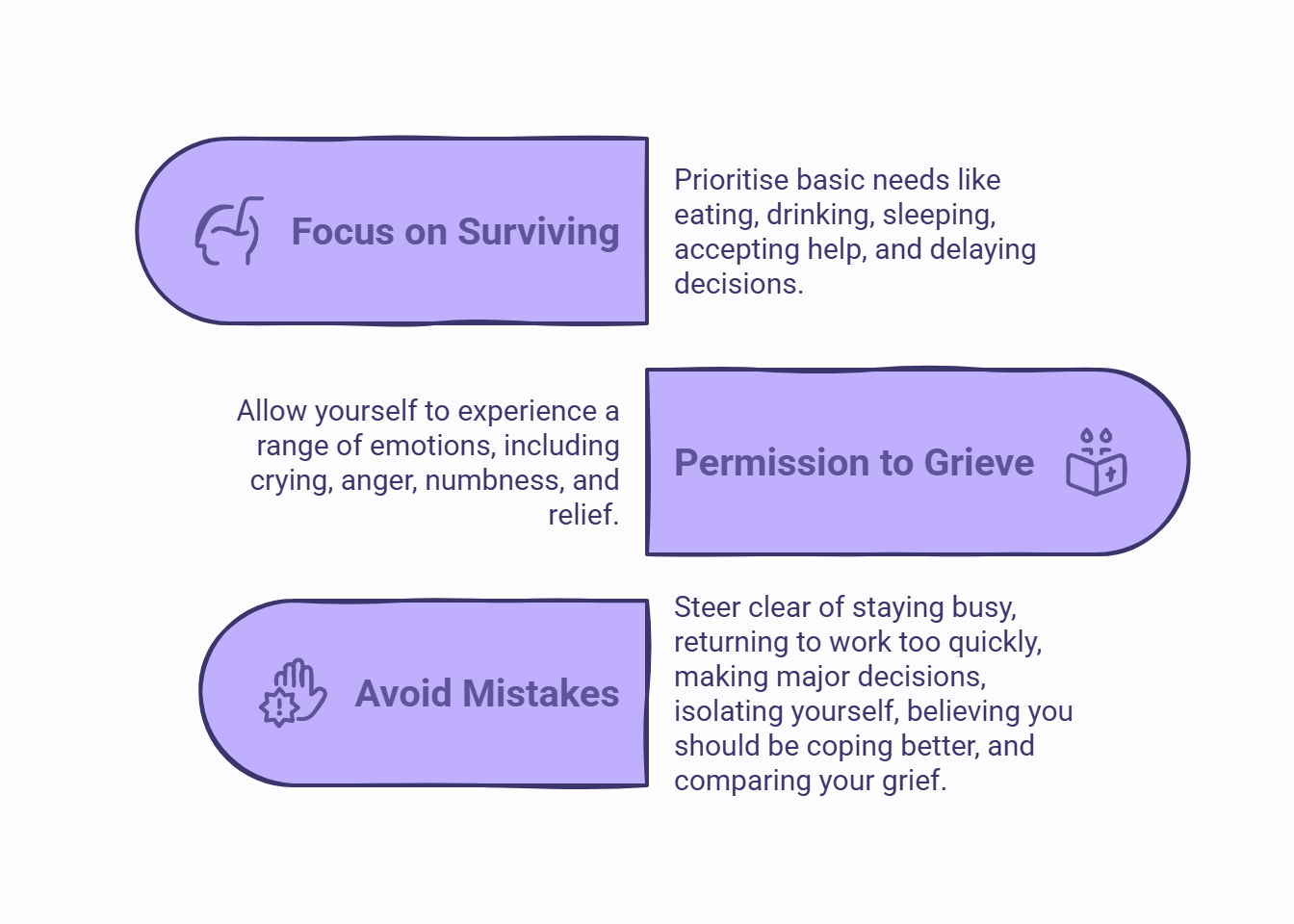
The first weeks after a loss often become a blur of paperwork, visitors, decisions, and exhaustion. Many people assume they should be finding ways to heal, when the immediate priority is usually much simpler: getting through each day with the least amount of additional pressure possible.
1. Focus on surviving before healing
In early grief, basic needs matter more than big breakthroughs. If possible, focus on:
- Eating something, even if your appetite disappears.
- Drinking water regularly throughout the day.
- Sleep whenever your body allows it.
- Accepting practical help from others.
- Delaying major decisions where possible.
These small actions create stability when everything else feels uncertain.
2. Give yourself permission to grieve badly
There is no correct emotional response to loss. Grief can include:
- Crying more than usual.
- Feeling unexpectedly angry.
- Experiencing emotional numbness.
- Laughing at memories and feeling guilty afterwards.
- Feeling relief after a difficult illness or caregiving period.
- Questioning whether you are grieving correctly.
Many people experience several of these emotions in the same day.
3. Avoid these common early grief mistakes
Some responses make grief harder rather than easier. Common examples include:
- Staying busy to avoid thinking about the loss.
- Returning to work too quickly because normality feels safer than grief
- Making major life decisions too quickly.
- Isolating yourself completely.
- Believing you should be coping better by now.
- Comparing your grief to somebody else's.
Giving yourself permission to move slowly is often one of the healthiest ways to deal with grief and loss.
The first weeks after a loss are rarely the time for fixing your life or finding closure. They are often about protecting your energy, lowering expectations, and giving yourself permission to do less while carrying far more than usual.
What actually helps when grief feels unbearable?
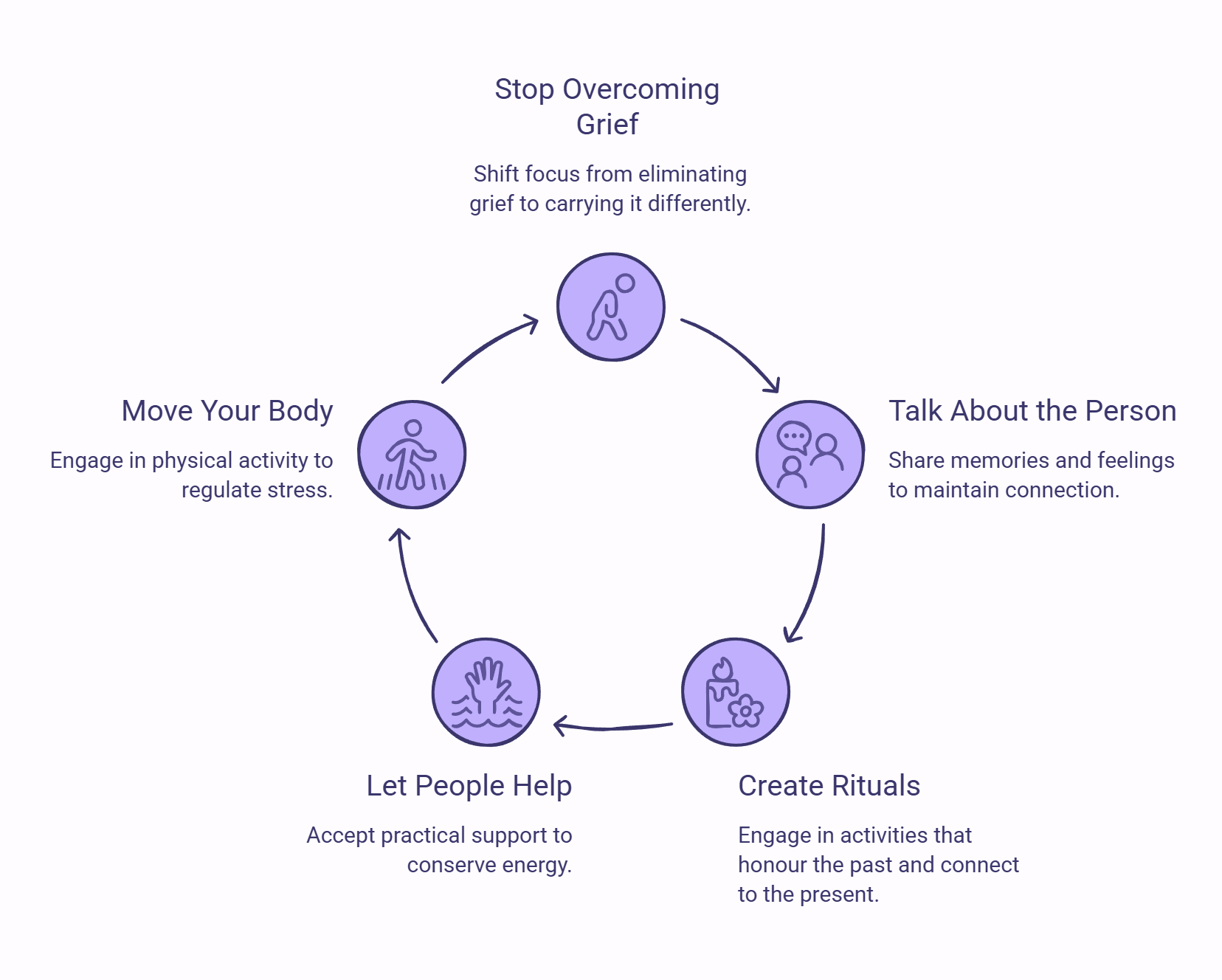
When grief feels unbearable, people often start searching for ways to make it stop. Yet research and lived experience suggest that the most helpful approaches are rarely about eliminating grief. They are usually about reducing isolation, creating connection, and making grief feel more survivable.
1. Stop asking how to overcome grief
Many people searching for how to deal with grief and loss hope that there will be a point where grief disappears completely. In reality, grief is not something you defeat or finish. Over time, the goal usually becomes learning how to carry it differently, live alongside it, and rebuild around it. This shift often makes coping with grief and loss feel less like a battle and more like an adjustment.
2. Talk about the person instead of protecting everyone from your grief
Many grieving people spend more energy protecting others from their grief than expressing it themselves. Helpful ways to keep talking include:
- Saying their name in conversation.
- Telling stories about them.
- Sharing memories that still matter.
- Discussing regrets or unresolved feelings.
Sometimes speaking to someone outside your immediate circle feels easier because you do not need to manage their emotions while processing your own. That is one reason many people seek spaces where listening matters more than advice.
3. Create rituals that keep the connection without keeping you stuck
Continuing bonds often support grief better than trying to let go completely. Some people find comfort in:
- Writing letters.
- Cooking favourite meals.
- Marking anniversaries intentionally.
- Creating playlists.
- Looking through photos regularly.
- Continuing traditions that mattered.
The goal is not to hold onto the past but to find a healthier place for it in the present.
4. Let people help in the ways they know how
Support is often most useful when it becomes practical rather than emotional. Friends and family may not know what to say, but they may be able to help with childcare, shopping, cooking, paperwork, or everyday tasks that suddenly feel overwhelming. Protecting your energy for grief rather than logistics is not a weakness. It is often one of the healthiest ways to cope.
5. Move your body even if motivation disappears
Movement can help regulate stress responses that often become heightened during grief. The goal is not fitness or productivity. Many people benefit more from:
- Grief walks without a destination.
- Gentle stretching.
- Gardening.
- Community movement activities.
- Time outdoors.
There is growing interest in grief movement groups and communal healing activities because movement often helps when words feel difficult.
Grief often becomes heavier in isolation and lighter in connection. Whether that connection comes through conversation, rituals, practical support, or simply moving through the world with others, healing rarely happens entirely alone.
If carrying this alone feels heavy, Listennr gives you a space to talk openly, at your own pace, without judgement or pressure to explain everything perfectly.
What changes depending on who you lost?
Not all grief feels the same because not all losses change your life in the same way. The relationship you had with the person often shapes the kind of grief you experience, the decisions you face, and the support that feels most useful.
1. How to deal with the grief of losing a parent?
Learning how to deal with the grief of losing a parent often means grieving more than the person themselves. Many people describe losing guidance, reassurance, and the feeling that someone older is still there to call. You may also find yourself becoming the family organiser or emotional anchor sooner than expected, creating role changes alongside grief.
2. How to overcome grief after the death of a spouse?
For many people, learning how to overcome grief after the death of a spouse means adjusting to hundreds of small absences rather than one large one. Every day routines suddenly feel lonely, financial decisions may become overwhelming, and your sense of identity can shift dramatically. Those with children may also find themselves navigating parenting responsibilities alone.
3. How to overcome the grief of losing a child?
Learning how to overcome the grief of losing a child often involves grieving both the child and the future you imagined together. Parents frequently experience identity grief, future grief, and strain within relationships as different family members grieve differently. Seeking support early is not giving up strength. It is recognising the weight of the loss.
4. How to deal with the grief of losing a friend?
The grief of losing a friend is often underestimated by others, but it can feel just as profound. You may lose shared routines, inside jokes, future plans, or the person who understood parts of your life that nobody else did. Because friendship grief is not always recognised in the same way as family loss, many people feel pressure to minimise it when they should be supported through it.
Why do different losses create different kinds of grief?
Grief is shaped not only by who you lost, but also by the circumstances surrounding the loss. Two people can experience very different kinds of grief even after similar events because relationships, timing, and context matter.
Different losses often bring different challenges:
- Sudden death can leave behind shock, unanswered questions, and a search for meaning.
- Expected death may bring exhaustion, relief, or guilt alongside sadness.
- Complicated relationships can create grief mixed with anger, regret, or unresolved feelings.
- Estrangement may lead to mourning a relationship that was already partly lost.
- Miscarriage often involves grieving a future that had already started to feel real.
- Divorce or separation can bring grief for shared plans, routines, and identity changes.
- Job loss may trigger grief linked to purpose, financial security, or self-worth.
Recognising the type of loss you are experiencing can make it easier to find support that matches what you are actually grieving, rather than what others assume you should be grieving.
Can grief last for years?
Many people quietly wonder whether they should be feeling better by now. The answer is often reassuring: grief does not always disappear with time. More commonly, it changes shape, becomes less constant, and finds a different place in your life.
1. Why does grief not follow a timeline?
One reason grief feels unpredictable is that life keeps creating new moments of loss. Common triggers include:
- Birthdays.
- Anniversaries.
- Weddings and graduations.
- The birth of children or grandchildren.
- Familiar songs, smells, and places.
- Ordinary moments you expected to share with them.
These experiences do not mean you are back at the beginning. They often mean grief has found a new place to appear.
2. How do you know whether this is grief or something more?
Missing someone years later is normal. Crying unexpectedly can be normal, too. The question is usually not how long grief has lasted but whether life has been able to continue around it.
It may be worth seeking additional support if you find yourself:
- Withdrawing from everyone around you.
- Struggling to manage daily responsibilities.
- Losing interest in activities you once enjoyed.
- Feeling persistently hopeless about the future.
- Feeling unable to imagine life ever changing.
Needing support does not mean you have failed at grieving. It usually means you have been carrying too much alone for too long.
3. Questions to ask yourself if grief feels unchanged
If your grief feels exactly the same as it did months or years ago, ask yourself:
- Am I avoiding reminders completely?
- Have I stopped talking to people about this?
- Have I lost interest in things that once mattered to me?
- Am I carrying this entirely alone?
- Have I convinced myself that asking for help would somehow betray them?
These questions are not designed to judge your grief. They are designed to help you understand what your grief may need next.
Grief lasting for years is not unusual. What matters more is whether grief has become your entire world or whether there is still space, however small, for connection, purpose, and moments of life to exist alongside it.
When does grief become loneliness?
For many people, grief becomes lonelier long before it becomes easier. The calls slow down, messages become less frequent, and life starts moving forward for everyone else while your grief remains.
People may stop mentioning the person's name because they do not want to upset you. Friends assume you would rather not talk about it. Over time, the silence itself can become painful.
Sometimes what people miss most is not advice or solutions. It has somewhere they can still say:
- "I miss him today."
- "I feel angry."
- "I don't know why this still hurts."
- "I don't want to upset my family."
Listening itself can become part of coping. Being heard without judgment or pressure to move on can help reduce the isolation grief often creates.
For some people, speaking to someone outside their immediate circle feels easier because they do not need to manage anyone else's emotions while processing their own.
Sometimes it helps to know you are not the only one feeling this way. Discover how Listennr conversations have helped others feel less alone.
What should you avoid saying to yourself while grieving?

The way you speak to yourself during grief matters. Certain beliefs can make grief feel heavier, increase isolation, or stop you from seeking support when you need it most.
1. I should be over this by now
Grief does not follow a timeline, and measuring your progress against weeks, months, or years rarely helps. Missing someone years later is not a sign that you are stuck. It is often a reflection of the importance of the relationship.
2. Other people have it worse
Comparing grief usually creates guilt rather than perspective. Your loss does not become less significant because someone else is suffering too. Acknowledging your pain is not selfish. It is often the first step towards coping with it more effectively.
3. I need to stay strong for everyone
Many grieving people become the organiser, supporter, or problem-solver for everyone around them. While responsibility can provide structure, carrying everyone else's emotions often leaves little space to process your own.
4. Talking about it will make it worse
Avoiding conversations may provide temporary relief, but silence often increases isolation over time. For many people, speaking about grief does not make it bigger. It simply makes it less lonely to carry.
5. I am grieving the wrong way
Some people cry often, while others become practical, quiet, angry, or emotionally numb. Different reactions do not mean someone cared less or loved less. There is no single version of grief that everyone is expected to follow.
Grief is already difficult enough without adding judgment, guilt, or unrealistic expectations to it. The goal is not to think the right thoughts or grieve in the right way. It is to notice which beliefs are making the weight heavier and give yourself permission to put them down.
What if you need to talk but do not know who to call?
Sometimes the hardest part of grief is not the grief itself. It is not knowing where to take it.
Not everyone has family available. Friends may be grieving too. And late nights often make thoughts feel heavier than they do during the day.
How Listennr provides a safe space to talk
At Listennr, the focus is not on fixing your grief or telling you how to move on. It is about giving you a space to talk openly, process what you are feeling, and feel heard without judgment.
With Listennr, you can:
- Talk about things you may not feel comfortable saying elsewhere.
- Connect with listeners who focus on understanding rather than fixing.
- Speak openly without worrying about burdening family or friends.
- Have conversations during difficult hours when grief often feels heaviest.
- Feel heard without pressure to explain why you are still hurting.
Sometimes, having someone genuinely listen cannot remove the loss, but it can make carrying it feel a little less lonely.
If you are looking for someone to talk to online, Listennr offers a space to start a conversation when you are ready.
You do not need to have all the answers right now
Grief is not something you solve, complete, or leave behind on a schedule. The goal is not to stop missing someone or to return to the person you were before the loss. It is to find ways to keep living while carrying what happened. If there is one decision worth making early, it is this: do not carry grief entirely alone. Whether that support comes from family, friends, a community, or simply someone willing to listen, connection often becomes part of healing itself.
Frequently asked questions
How long does grief typically last, and what is considered normal?
Grief has no fixed period of time. The effects of grief can feel intense for months and return unexpectedly years later. Missing someone long after a loss is often normal, especially around important dates and milestones.
Are there special strategies for coping after losing a parent?
Losing a parent can affect identity, security, and family roles. Many people find comfort in maintaining routines, sharing memories, writing down thoughts, and focusing on manageable, specific tasks during difficult periods.
How can I best support a grieving friend or family member?
Listen without trying to fix the situation. Stay in touch, offer practical help, and let them set the pace of conversations. Compassionate support can make feelings of sadness feel less isolating and overwhelming.
What resources are available for free counseling or support during grief?
Many communities offer free grief support through charities, bereavement organisations, support groups, faith communities, and helplines. Some people also find comfort in anonymous listening services that provide space to talk openly without pressure, advice, or judgment.
How to deal with grief?
There is no single way through the experience of grief after a significant loss. Some of the healthiest ways to deal with grief include maintaining routines and making space for complex feelings, even when grief feels like a roller coaster.
How to deal with the grief of losing a father?
Losing a father can feel like losing guidance and reassurance. The feelings of grief often return during milestones, family moments, or times when you wish you could ask for his advice, even as time passes.
How to overcome grief after the death of a husband?
The loss of a spouse changes everyday life in unexpected ways. The burden of grief can feel heaviest during quiet routines, making support and small ways to cope with grief especially important.