.jpg)
How Do You Find Someone Who Understands You in 2026?

Key highlights
- Feeling misunderstood often has more to do with connection quality than the number of people in your life.
- Deep conversations create understanding by exploring experiences, not just exchanging information.
- People who truly understand you make it easier to be honest without constantly explaining yourself.
- Genuine understanding can help you gain clarity about your own thoughts and feelings.
- Emotional safety allows conversations to feel supportive rather than exhausting.
- Finding someone who understands you usually happens through trust, curiosity, and consistent listening.
- Not everyone will understand you deeply, and that is a normal part of human relationships.
- Sometimes being heard is the first step toward feeling less alone and more connected.
- When finding someone who understands you feels difficult, Listennr offers a safe space to talk and feel heard.
You can spend an entire day talking to people and still feel like nobody truly understands you. Maybe you've tried explaining what's on your mind, only to hear advice when what you really wanted was understanding. Or perhaps you've walked away from a conversation thinking, "That's not what I was trying to say."
The frustrating part is that this can happen even with people you care about. You can be surrounded by friends and family. Or messages on your phone and still feel like the most important part of what you're carrying never quite reaches anyone else. Sometimes the problem isn't a lack of people, it's a lack of genuine understanding.
Finding someone who understands you is about more than having someone to talk to. It's about feeling safe enough to be honest, knowing you won't be judged, and experiencing a connection that makes you feel less alone. In this guide, we'll explore why that connection can feel so rare and how to find it.
What does it mean to find someone who understands you?
Finding someone who understands you means feeling like you no longer have to translate yourself. Instead of carefully choosing every word or explaining the same feeling multiple times, you feel like the other person understands what you are trying to say and why it matters to you.
Think about the last time you shared something important. Maybe the conversation quickly turned into advice, comparisons, or someone else's story.
Being understood feels different. The focus stays on your experience. You do not feel rushed, dismissed, or pulled in another direction before you've had a chance to finish your thought.
People who understand you often:
- Show kindness by making it easier to be honest about what you feel.
- Ask questions because they want to learn more.
- Make it easier to be honest about what you feel.
- Leave you feeling clearer rather than more frustrated.
That difference matters because genuine understanding helps build trust. When you feel understood, it becomes easier to open up, communicate honestly, and develop deeper connections with others.
Why do so many people feel misunderstood?
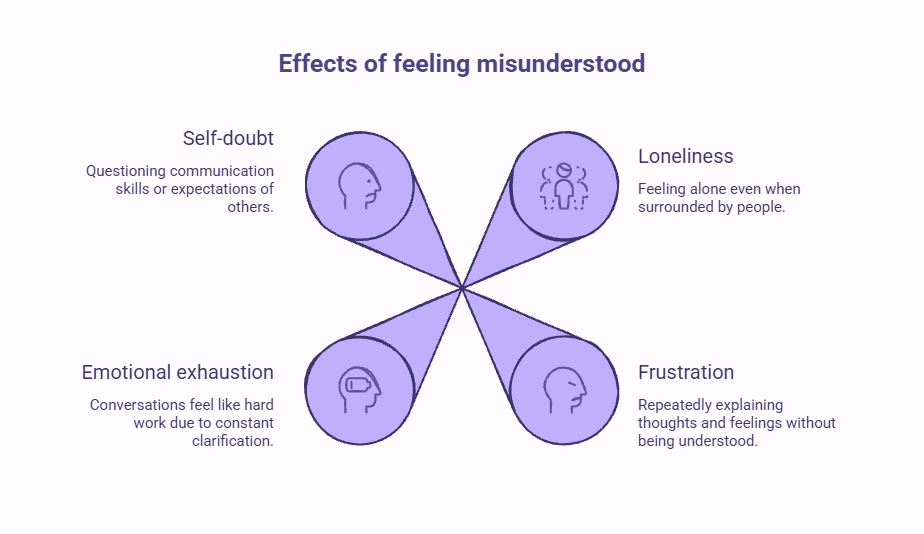
Feeling misunderstood can be surprisingly painful because it affects more than a single conversation. When someone repeatedly misses what you are trying to say, it can leave you feeling alone even when people are around you.
Over time, that experience can show up in different ways:
- Loneliness: You have people to talk to on social media, but still feel like nobody really gets what you are going through.
- Frustration: You find yourself explaining the same thoughts and feelings repeatedly without feeling any closer to being understood.
- Emotional exhaustion: Every conversation starts to feel like hard work because you expect to clarify, defend, or repeat yourself.
- Self-doubt: After enough misunderstandings, you may start questioning whether you are communicating poorly or expecting too much from others.
That is why finding someone who understands you can feel so meaningful. It is not just about agreement. It is about finally feeling like your experiences, thoughts, and emotions have been accurately seen by another person.
Why are deep conversations with someone who understands you so powerful?
Deep conversations matter because they help people from different backgrounds feel understood in ways that everyday interactions often do not. Instead of talking about schedules, updates, or surface-level topics, these conversations create space for honesty, reflection, and emotional connection.
People often value deep conversations because they:
- Help them express thoughts they have been carrying for a long time.
- Reduce the frustration of feeling misunderstood.
- Create a stronger sense of trust and closeness.
- Offer new perspectives without making them feel judged.
- Make it easier to understand their own feelings.
Many people notice the difference after the conversation ends. Rather than replaying what they should have said, they feel clearer, calmer, or more connected. Sometimes the biggest benefit is not getting advice. It is finally feeling like someone understood what they were trying to say.
Why small talk often leaves us feeling disconnected
Small talk helps people stay connected, but it rarely creates the same sense of understanding. Conversations about work, weather, daily routines, or social updates serve a purpose within our social networks, yet they often stop before anything meaningful is shared.
That can leave people feeling disconnected because:
- The conversation never moves beyond safe topics.
- Important thoughts and feelings remain unspoken.
- People learn what is happening in your life, but not how you feel about it.
- There is little opportunity for emotional connection.
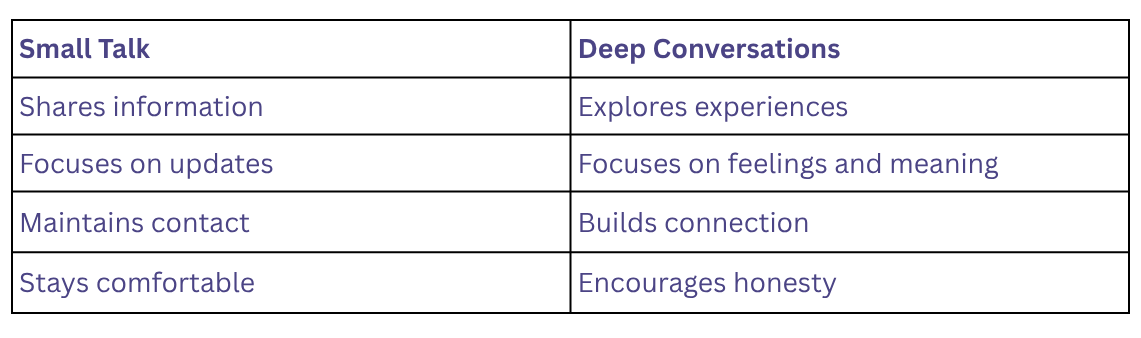
You do not need every conversation to be deep. However, if every conversation stays at the surface, it becomes much harder to feel genuinely understood by the people around you.
What are the signs that someone truly understands you?
You usually notice it in the moments when you stop working so hard to be understood. Most people know what it feels like to explain the same thing three different ways because the other person is not quite getting it. When someone truly understands you, that effort starts to disappear.
A few signs tend to stand out:
- You do not spend the conversation correcting misunderstandings.
- You feel comfortable sharing the full story instead of the edited version.
- The other person understands why something matters to you, even if they would react differently.
- They remember the things that matter to you and bring them up with genuine care.
- You leave the conversation feeling relieved rather than drained.
- You do not replay the conversation later, wondering whether you explained yourself properly.
One of the strongest signs is that you feel more like yourself around them. You are not carefully managing their reactions, choosing every word with caution, or hiding parts of what you think. The conversation feels natural because understanding is already present.
Can the right person help you understand yourself better?
Yes, sometimes another person helps you notice things about yourself that are difficult to see on your own. Have you ever started talking about a problem and realised halfway through the conversation what was actually bothering you? The insight did not come from advice. It came from having the space to think out loud.
The right person can help you understand yourself better by:
- Noticing patterns you overlook.
- Asking questions that make you think differently.
- Reflecting back on what they hear while giving you their full attention without changing the meaning.
- Helping you connect experiences that seem unrelated.
This is not because they know you better than you know yourself. It is because they are looking at the situation from a different angle. Sometimes that perspective makes things easier to understand.
What does emotional safety feel like?
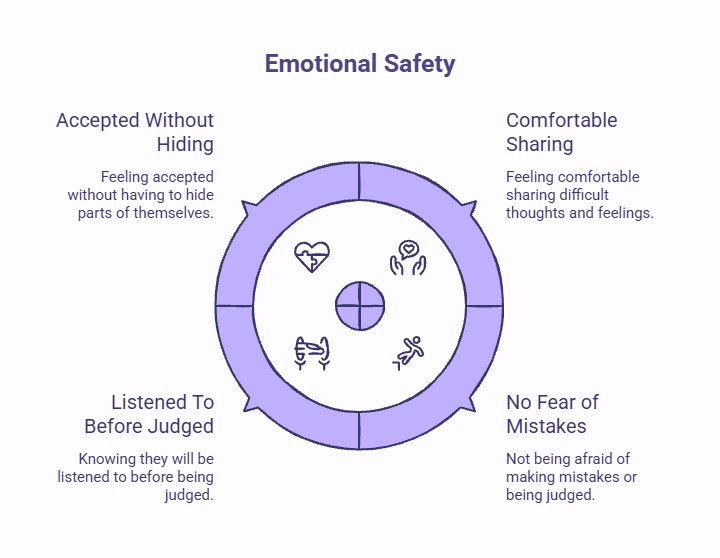
When someone consistently understands you, another important feeling often starts to develop: emotional safety and empathy. Instead of worrying about how your words will be received, you become more comfortable sharing what is actually on your mind.
Emotional safety is the feeling that you can speak honestly without worrying that your feelings will immediately be dismissed, mocked, or turned against you. You do not have to carefully calculate every sentence or defend every emotion. Even when there is disagreement, the conversation still feels respectful.
People often describe emotional safety as:
- Feeling comfortable sharing difficult thoughts.
- Not being afraid of making mistakes.
- Knowing they will be listened to before being judged.
- Feeling accepted without having to hide parts of themselves.
That sense of safety often determines whether conversations create connection or distance. When it is present, honesty feels easier. When it is missing, even simple conversations can feel draining.
How do you find someone who understands you?
People often expect understanding to appear in the closest relationships they already have. Sometimes it does. Other times, it develops in places where people feel more comfortable sharing openly, often coming from a place of love, and listening without judgment.
Some of the most common places people find genuine understanding include:
- Close friendships are built on trust and honest conversations.
- Supportive communities where people share similar experiences or challenges.
- Online listening platforms that create space for open, one-on-one conversations.
- Shared-interest groups where regular interaction helps relationships develop naturally.
The place matters less than the quality of the conversation. People are more likely to feel understood in environments that encourage curiosity, honesty, and emotional openness rather than quick opinions or surface-level interactions.
What should you do if you feel like nobody understands you?
The first thing to consider is whether nobody understands you, or whether you keep looking for a little bit of understanding in places where it rarely exists.
Many people return to the same conversations, hoping for a different outcome. They explain themselves to the same friend, family member, or partner and leave feeling frustrated every time. Eventually, the problem starts to feel personal when it may actually be a mismatch in communication, emotional capacity, or expectations.
It can also help to rethink what understanding looks like.
Some people expect complete understanding before they feel connected. They want someone who immediately understands every feeling, reaction, and experience. That expectation often leads to disappointment because even strong relationships involve misunderstanding from time to time.
Instead, ask yourself:
- Who makes me feel comfortable being honest?
- Who becomes curious rather than defensive?
- Who remembers what matters to me?
- Who leaves me feeling clearer rather than more confused?
The answers are often more revealing than asking who understands you perfectly.
Finding understanding is usually less about finding one perfect person and more about recognising the people who consistently make room for your perspective.
Where Can You Find Someone Who Understands You?
Finding someone who understands you is not always about finding the perfect friend, partner, or mentor. Sometimes, it starts with finding a space where you can talk openly without worrying about being judged, interrupted, or misunderstood.
At Listennr, conversations are built around listening and understanding rather than giving quick advice or trying to fix what you're feeling.
Why people choose Listennr
- A space to talk openly at your own pace
- Listeners who focus on understanding before responding
- One-to-one conversations without judgment
- The freedom to share what is on your mind without pressure
- A chance to feel heard when understanding feels difficult to find elsewhere
Not every conversation needs solutions.
Sometimes, what makes the biggest difference is having someone who genuinely listens and takes the time to understand your perspective.
If you're looking for someone who understands you, Listennr is a place to start the conversation.
Conclusion
Feeling misunderstood does not always mean there is something wrong with you or your insecurities and relationships. Often, it means you have not yet found the people who see your good intentions and make it easy to be honest, open, and fully yourself. Genuine understanding is rarely instant; in fact, this is the hardest thing to achieve. It develops through conversations where curiosity matters more than assumptions.
As you move forward, pay attention to how people make you feel after a conversation about your own life. The people who truly understand you are often the ones who leave you feeling clearer, lighter, and less alone.
Frequently asked questions
How can I connect with people who will truly understand me?
Connect with people who show genuine curiosity, respect your perspective, and make space for honest conversations. Meaningful understanding often grows through shared trust, emotional vulnerability, openness, and consistent communication rather than instant connection.
Why is it so hard to find someone who truly understands me?
Because understanding requires more than frequent communication and validation. People bring different experiences, assumptions, and ways of expressing themselves into conversations. Many interactions stay at a surface level, making it difficult to share what really matters. Genuine understanding usually develops through trust, honesty, and consistent effort over time.
How do I communicate with people who don't seem to understand me?
Be clear about what you mean and what you need from the conversation. If misunderstandings continue, focus your energy on people who show curiosity, ask questions, and make a genuine effort to understand your perspective with compassion.
Are deep conversations important for feeling understood?
Be clear about what you mean and what you need from the conversation. If misunderstandings continue, focus your energy on people who show curiosity, ask questions, and make a genuine effort to understand your perspective.
What are the signs that someone genuinely gets how I feel?
Some common signs include feeling comfortable being honest, not needing to repeatedly explain yourself, and leaving conversations feeling understood rather than frustrated, even if you’re having a hard time. They listen with curiosity, remember what matters to you, and make space for your perspective.
How can I tell if someone really understands me?
You can often tell by how you feel after the conversation. If you do not have to keep explaining yourself, feel comfortable being honest, and leave feeling clearer rather than frustrated, there is a good chance the other person genuinely understands you.