%20(1).jpg)
Self Care Ideas: Which Ones Actually Work?

Key highlights
- Self-care works best when it addresses the real source of stress and your personal needs.
- Small, consistent habits can support both mental health and physical health in daily life.
- Processing emotions and talking openly can improve mental clarity and reduce emotional pressure.
- Being heard without judgment can be a valuable form of self-care.
- Reaching out early can help prevent stress from becoming overwhelming.
- A realistic self-care routine is easier to maintain and adapt over time.
- Listennr helps you make conversation part of self-care through supportive, judgement-free listening.
You tell yourself to practise self-care, yet nothing seems to stick. One week you are following new habits, and the next they have disappeared. Despite trying different self-care activities, you may still feel stressed, emotionally drained, disconnected, or unsure why you are struggling in the first place.
The problem is that many self-care tips focus on activities rather than needs. A relaxing habit may help temporarily, but it will not always address mental overload, loneliness, emotional exhaustion, or the pressure of carrying too much on your own.
This guide goes beyond a simple list of self-care ideas. It will help you understand why self-care matters, recognise what support you actually need, and choose practical ways to take care of yourself. You will also discover why being able to talk openly can be an important form of self-care.
Why do so many self-care ideas stop working after a few days?
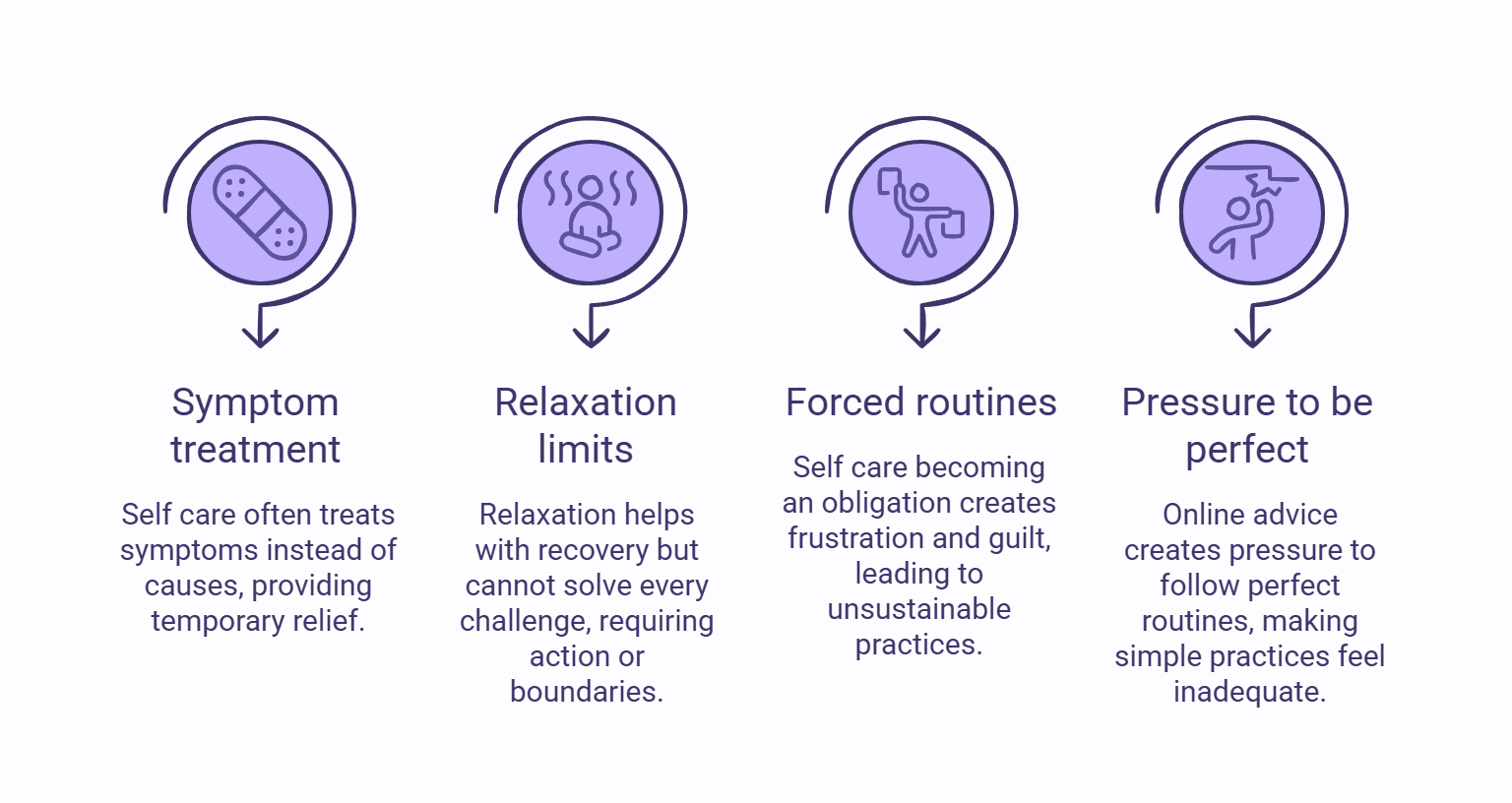
Most self-care ideas fail for the same reason many diets fail. People focus on following activities instead of understanding needs. A routine may look healthy on paper, but if it solves the wrong problem, motivation usually disappears quickly.
1. Self-care often treats symptoms instead of causes
Many self-care activities provide temporary relief without addressing what is creating the stress. If workload, loneliness, unresolved conflict, or emotional pressure remain unchanged, the benefits fade quickly. Effective self-care practices start by identifying the source of the discomfort first.
2. Not every problem can be solved with relaxation
Relaxation helps when your mind or body needs recovery, but it cannot solve every challenge. Some situations require action, difficult conversations, stronger boundaries, or emotional expression. Understanding the difference helps you choose self-care tips that match the situation.
3. Why forcing routines can make you feel worse
When self-care becomes another obligation, it can create frustration instead of support. Following routines that do not fit your lifestyle often leads to guilt when you miss them. Sustainable self-care works with your reality rather than against it.
4. The hidden pressure to "do self-care correctly"
Online advice often presents self-care as a perfect routine filled with productive habits. This can create unnecessary pressure and make simple practices feel inadequate. Learning how to do self-care means choosing what genuinely helps, not what looks impressive.
The most effective self-care ideas are not always the most popular ones. Lasting results come from matching the solution to the real challenge. Before adding another habit, identify what actually needs attention, support, or change.
Before choosing self-care, what are you actually trying to fix?

Not all self-care ideas deliver the same benefits. Self-care is often grouped into five areas: physical, mental, emotional, social, and spiritual well-being. The most effective approach depends on which of these areas feels neglected. Instead of asking which self-care activities are popular, ask which part of your well-being is asking for support today.
1. When your body needs recovery
Persistent tiredness, poor sleep quality, frequent headaches, or low physical energy often indicate recovery needs. In these situations, prioritise restorative habits such as sleep consistency, hydration, gentle movement, and adequate nutrition before focusing on more demanding self-care activities.
2. When your mind needs quiet
A constantly active mind can make concentration and decision-making difficult. If your thoughts feel scattered, create periods without notifications, unnecessary information, or multitasking. Giving your brain fewer inputs often restores clarity more effectively than adding new routines.
3. When your emotions need expression
Emotions rarely disappear because they are ignored. If frustration, sadness, disappointment, or worry keep resurfacing, focus on outlets that encourage expression. Writing, creative activities, or open conversations can help process feelings rather than continually carrying them forward.
4. When your relationships need attention
Sometimes the issue is not personal well-being but disconnection from others. If interactions feel superficial or distant, invest in meaningful conversations and quality time. Strong relationships can become an important part of how to practice self-care successfully.
5. When your sense of purpose or meaning feels disconnected
Spiritual self-care is not necessarily about religion. It can involve reflecting on your values, spending time in nature, practising gratitude, or engaging in activities that give your life meaning. If you feel disconnected, directionless, or unfulfilled, nurturing this part of your well-being can help restore balance.
6. When you simply need someone to listen
There are moments when advice, productivity tips, or problem-solving are not helpful. Speaking openly without judgment can create relief and perspective. Being heard allows thoughts to settle, making conversation one of the most overlooked self-care ideas.
Choosing the right self-care starts with recognising what feels neglected. Whether your body, mind, emotions, or relationships need support, matching the response to the need helps self-care become more effective and sustainable over time.
Want to be heard? Talking to someone can be one of the simplest self-care practices. See how Listennr has helped others.
What are the most effective self-care ideas for emotional overload?
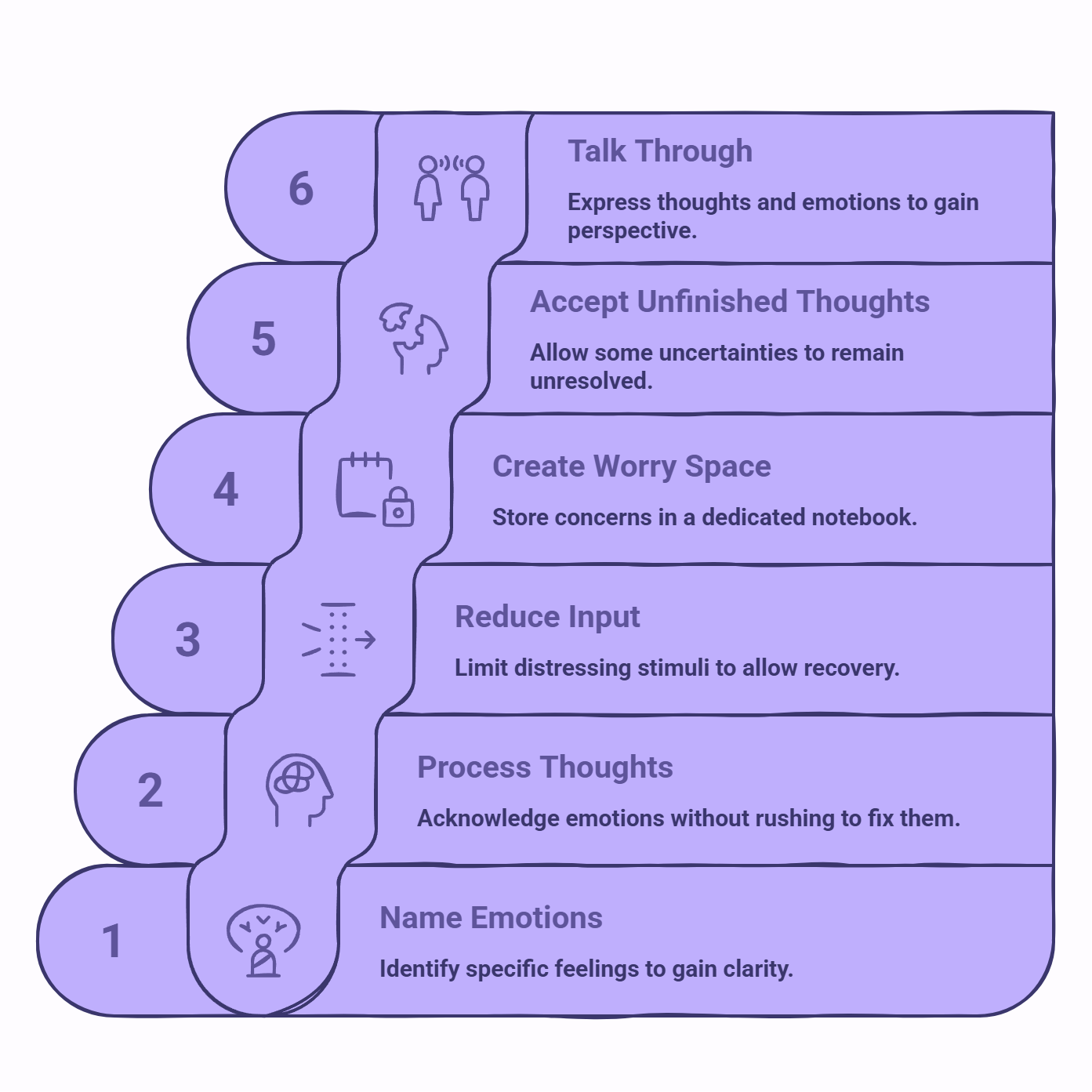
Emotional overload often feels less like one major problem and more like dozens of unresolved thoughts competing for attention. The goal is not to eliminate every feeling immediately but to reduce internal pressure before it becomes overwhelming.
1. Name what you are actually feeling
People often describe themselves as stressed when they are experiencing disappointment, resentment, guilt, loneliness, or uncertainty. Identifying the specific emotion creates clarity. Accurate emotional labelling helps you respond appropriately instead of applying generic self-care ideas to every situation.
2. Stop solving and start processing
Many people immediately search for solutions before understanding their reaction to a situation. Processing means acknowledging thoughts and emotions without rushing to fix them. This approach often reduces emotional intensity and creates better decisions than constant problem-solving.
3. Reduce emotional input for a day
When you already feel emotionally overloaded, additional inputs can increase mental strain. Consider limiting distressing news, emotionally charged social media, or draining conversations temporarily. Creating space from constant emotional stimulation allows your mind to recover and reset.
4. Create a worry parking space
Repeated worries often demand attention because the brain fears they will be forgotten. Keep a dedicated notebook or digital note where concerns can be stored. This simple self care practice reduces mental repetition and helps organise scattered thoughts.
5. Let yourself have unfinished thoughts
Not every question needs an immediate answer. Trying to resolve every uncertainty can create additional stress. Accepting that some situations require time allows your mind to stop chasing solutions and focus on what can be addressed now.
6. Talk through what's on your mind
Speaking about your thoughts often reveals patterns, concerns, and emotions that remain hidden internally. Conversation creates perspective and reduces pressure. For many people, being able to talk openly is one of the most effective self-care activities available.
Emotional overload rarely disappears through distraction alone. The most effective self-care practices create space for understanding, processing, and expressing what you are experiencing. When emotional pressure is acknowledged, it becomes easier to move forward with clarity.
Why can talking be one of the most underrated forms of self-care?
Most self-care ideas focus on things you can do independently. While those approaches have value, they often overlook one important need: expression. Sometimes what helps most is not another habit or routine, but the opportunity to put your thoughts into words and feel heard.
When thoughts stay internal, worries can feel larger, and emotions become harder to understand. Talking helps organise what you are experiencing, making it easier to gain perspective and process difficult feelings.
Why does being heard feel different from receiving advice?
Advice focuses on solving problems. Listening focuses on understanding them. When someone genuinely listens, they give you space to:
- Explore your thoughts without interruption
- Understand your emotions more clearly
- Reach your own conclusions
- Feel acknowledged rather than corrected
This is why being heard often feels valuable even when no practical solution is offered.
How are neutral listeners different from friends and family?
Friends and family can be incredibly supportive, but they may also bring personal opinions or expectations into the conversation. Neutral listeners focus on listening, making it easier to:
- Discuss sensitive topics openly
- Share thoughts without fear of judgment
- Talk without worrying about burdening someone
- Express yourself honestly
This keeps the core message while reducing repetition and word count.
When do you need a listener more than another self-care activity?
Not every challenge can be managed alone. Sometimes the most effective form of self-care is talking through what you are experiencing with someone who will listen. You may benefit from speaking to a listener if you:
- Keep replaying the same thoughts
- Feel emotionally exhausted despite practising self-care
- Bottle up feelings to avoid burdening others
- Feel disconnected from people around you
- Struggle to switch off mentally
- Need understanding more than advice
- Feel like you are carrying everything alone
Sometimes, being heard is the self-care practice that helps you move forward with greater clarity and less emotional pressure.
When conversation becomes part of a healthy self-care routine
Talking does not have to wait until you feel overwhelmed. Making space for regular conversations can help you process emotions, recognise challenges earlier, and support your emotional wellbeing over time.
Sometimes you do not need another routine or productivity tip. You simply need someone who will listen without interrupting or trying to fix everything. That is where Listennr can help.
What should you stop doing in the name of self-care?

Not every habit labelled as self-care supports well-being. Some behaviours feel productive or comforting in the moment but can quietly prevent progress. Recognising these patterns is just as important as learning how to practice self-care effectively.
1. Using self-care as avoidance
Self-care should support your well-being, not help you avoid important responsibilities indefinitely. If relaxation becomes a way to postpone necessary decisions, conversations, or actions, stress often returns stronger. Healthy self-care creates the capacity to face challenges, not escape them.
2. Constantly consuming motivational content
Reading articles, watching videos, and saving self-care tips can feel productive, but information alone rarely creates change. If you spend more time learning than applying, focus on implementing one useful practice before searching for another source of inspiration.
3. Comparing your recovery to other people
People recover from stress, loss, and difficult experiences at different speeds. Comparing your progress to someone else's can create frustration and unrealistic expectations. A more effective approach is to measure improvement against your own circumstances, needs, and starting point.
4. Waiting until burnout to take care of yourself
Many people only prioritise self-care when exhaustion becomes impossible to ignore. Unfortunately, recovery usually takes longer once burnout develops. Building small, consistent self-care practices into everyday life is often more effective than relying on emergency fixes.
5. Believing self-care must be expensive or time-consuming
Some of the most valuable self-care activities cost nothing. Setting boundaries, getting enough sleep, taking a short walk, or having a meaningful conversation can support well-being without requiring large amounts of money, planning, or free time.
Effective self-care is often about removing unhelpful habits rather than adding new ones. By avoiding these common mistakes, you can focus your energy on self-care practices that create lasting benefits instead of temporary relief.
How to take care of oneself when you have very little time?
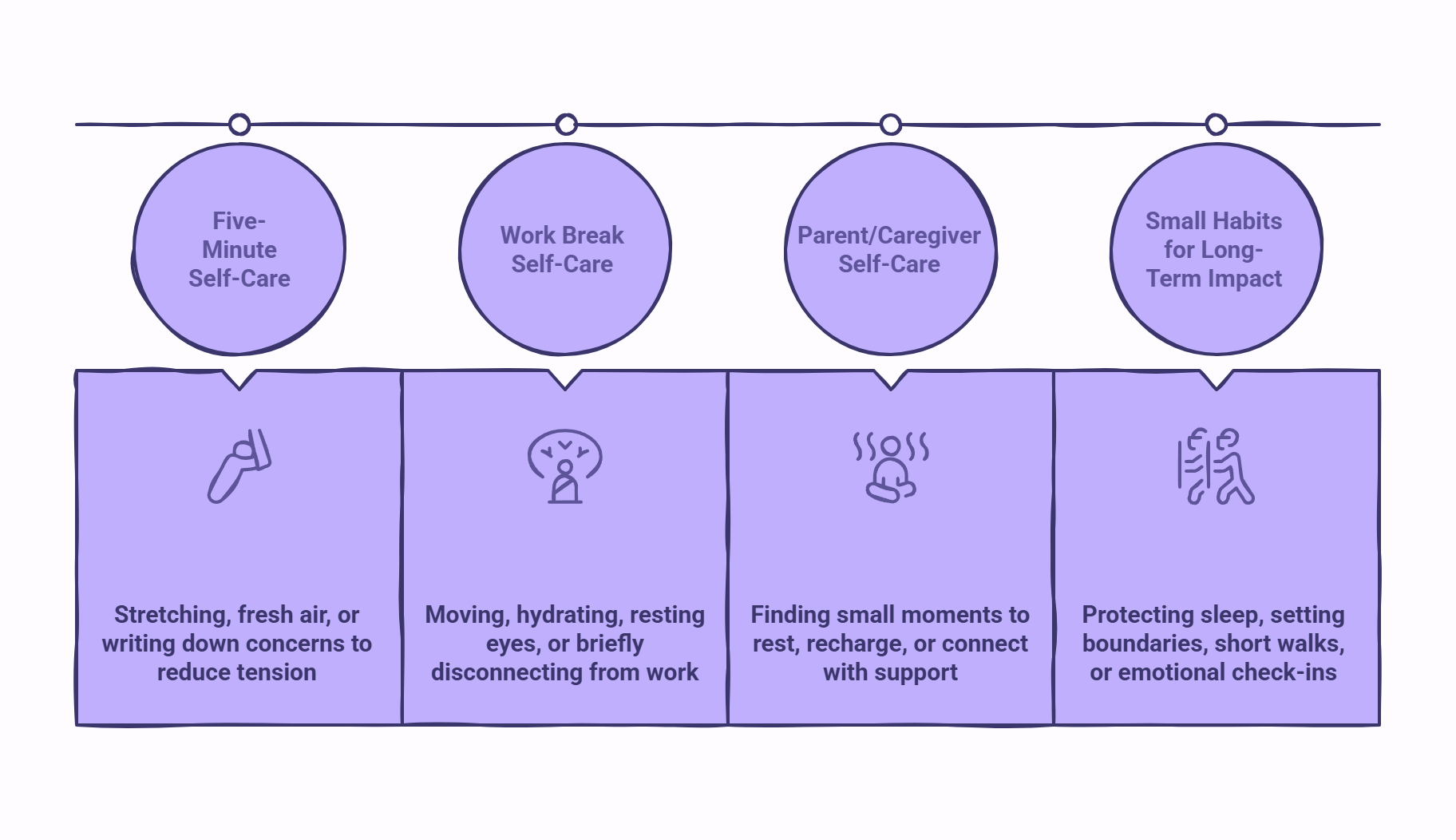
One of the biggest misconceptions about self-care ideas is that it requires large blocks of free time. In reality, many effective self-care practices work because they fit into busy schedules, making them easier to maintain consistently over time.
1. Five-minute self-care practices
Short activities can still support well-being when done intentionally. Stretching, stepping outside for fresh air, writing down a concern, or taking a few minutes to reset between tasks can help reduce tension without disrupting your entire day.
2. Self-care during work breaks
Many people spend breaks scrolling through emails or social media, which often extends mental fatigue. Instead, use part of your break to move, hydrate, rest your eyes, or briefly disconnect from work-related demands.
3. Self-care ideas for parents and caregivers
Parents and caregivers often place their own needs at the bottom of the priority list. Rather than waiting for extended free time, look for small opportunities throughout the day to rest, recharge, or connect with supportive people.
4. Small habits that create long-term impact
Sustainable self-care rarely depends on major lifestyle changes. Consistent habits such as protecting sleep, setting boundaries, taking short walks, or checking in with your emotional well-being can create meaningful benefits when practised regularly.
The effectiveness of self-care is not determined by how much time you spend on it. Small actions repeated consistently often have a greater impact than occasional intensive efforts that are difficult to maintain long-term.
How do you know your self-care routine is actually working?
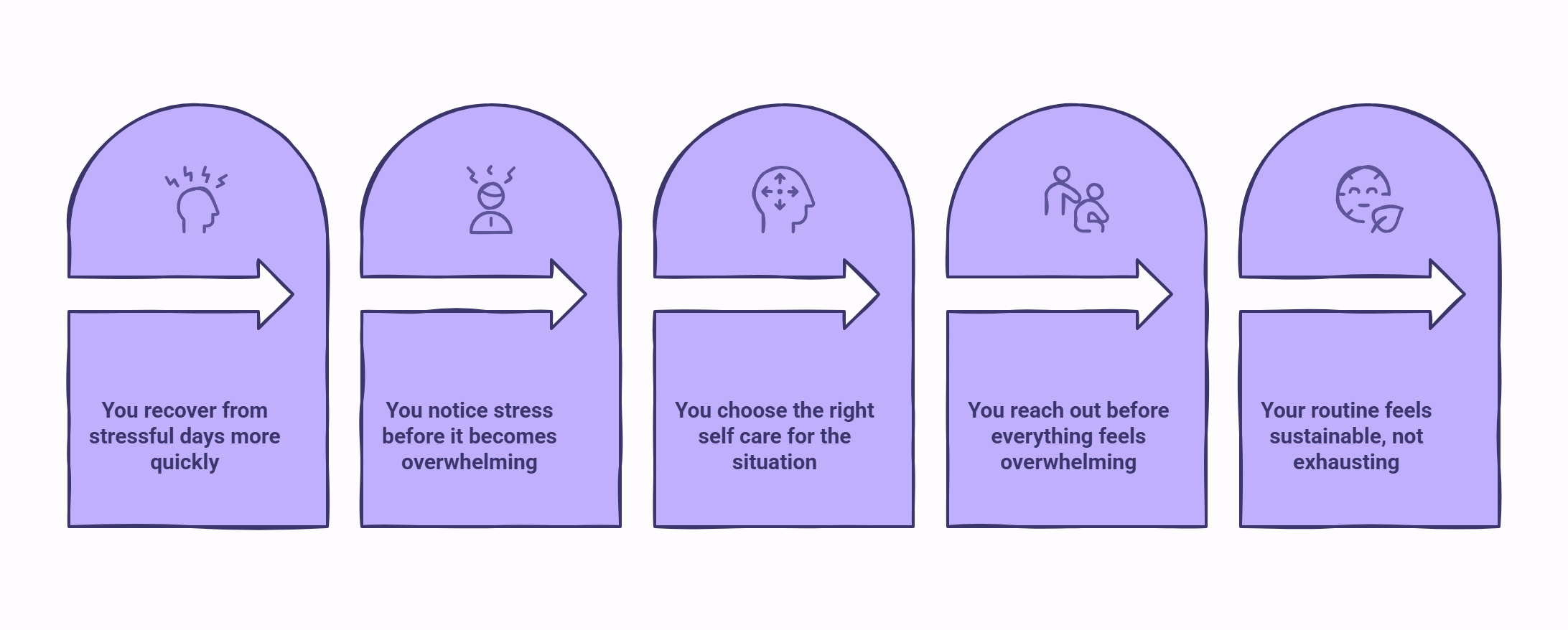
A self-care routine should make everyday life feel more manageable, not simply fill your schedule with healthy habits. Instead of tracking perfection, look for small but meaningful changes in how you respond to stress, challenges, and your overall well-being.
1. You recover from stressful days more quickly
Stressful situations may still happen, but they no longer affect you for days. If you feel calmer, regain your energy sooner, and find it easier to move forward after setbacks, your self-care routine is supporting your wellbeing.
2. You notice stress before it becomes overwhelming
A good routine improves self-awareness. You begin recognising signs such as irritability, poor sleep, or mental fatigue earlier, allowing you to adjust your habits or seek support before stress becomes more difficult to manage.
3. You choose the right self-care for the situation
Instead of relying on one solution for every problem, you naturally choose what you need. Rest, movement, quiet time, connection, or conversation all have different purposes, and your choices become more intentional over time.
4. You reach out before everything feels overwhelming
One sign of healthy self-care is recognising when you need support. Rather than carrying everything alone, you feel more comfortable reaching out, expressing your feelings, or talking to someone before emotional pressure builds.
5. Your routine feels sustainable, not exhausting
A routine should support your life rather than control it. If your habits remain practical during busy weeks and you no longer feel guilty for missing a day, they are more likely to last.
A self-care routine is working when it helps you manage life more effectively, not when it looks perfect. Small improvements in awareness, resilience, and emotional well-being often matter far more than completing every habit every day.
How do you make conversation part of a self-care routine?
Not every conversation needs advice or solutions. Sometimes you simply need a space to talk openly about what is on your mind. Listennr is designed for those moments. It connects you with listeners who provide emotional support through genuine human connection and attentive listening.
With Listennr, you can:
- Talk openly without judgment
- Feel heard and understood
- Share what is weighing on your mind
- Connect with someone focused on listening, not advising
For many people, being heard is not just comforting. It is an important self-care practice that helps relieve emotional pressure and create clarity.
You do not have to carry everything alone. Join Listennr today and find a supportive space where you can talk openly and feel heard.
Self-care works best when it reflects what you truly need
The most effective self-care ideas go beyond routines and address what is actually affecting your well-being. Whether you need rest, stronger boundaries, meaningful connection, or space to express your thoughts, the right support can make a real difference.
The goal is not to follow every self-care trend but to choose self-care practices that genuinely help you feel better. Sometimes, one of the most valuable forms of self-care is simply having someone who will listen when you need to talk.
Frequently asked questions
How to relax our minds quickly with self-care activities?
If you are wondering how to relax your mind, try deep breathing, meditation, or a short screen break away from blue light. These practices support emotional regulation, reduce stress levels, and improve mental wellness within minutes.
Why is it important to practice self-care regularly?
Regular self-care supports quality of life, healthy energy levels, and long-term personal growth. It can reduce the risk of illness, improve emotional well-being, strengthen compassion for yourself, and help manage everyday stress more effectively.
How can I start self-care if I have never done it before?
Begin with one simple habit, such as drinking plenty of water, taking a short walk, or setting aside time for physical activity. Small, sustainable actions often support spiritual growth, well-being, and healthier routines over time.
What are some simple ways to take care of myself every day?
Some of the most effective self care ideas are simple. Prioritising adequate sleep, regular physical activity, deep breathing exercises, and time with family members can support emotional health, improve positivity, and contribute to good health over time.
How can I develop a daily self-care routine?
Start with small ways to improve overall health, such as adequate sleep, a balanced diet, regular exercise, and plenty of water. Add journaling, meditation, or yoga if helpful, and focus on consistency rather than perfection.
Why is practicing self-care important for overall well-being?
Practising self-care supports your overall well-being by reducing stress, improving physical and emotional health, strengthening resilience, and helping you manage everyday challenges. Small, consistent self-care practices can make a lasting difference to how you feel each day.