.jpg)
App to Talk to Someone When Depressed: Which Is Best?

Key highlights
- Different apps serve different needs, from peer listening to professional mental health care.
- Peer-listening apps can provide confidential support and human connection without a therapy setting.
- Privacy and clear listener roles matter when discussing difficult feelings online.
- A simple opening message can make reaching out easier during a tough time.
- Persistent symptoms or warning signs may mean professional support is more appropriate.
- Suicidal thoughts or immediate safety concerns require urgent help through an appropriate crisis lifeline or emergency service.
- Listennr offers one-to-one conversations with real people when you primarily want to be heard.
Wanting to talk to someone and having someone you feel able to talk to are two different things. You may not want to explain what you are going through to a friend, worry about burdening your family, or find that nobody is available when you need them. An app to talk to someone when depressed can provide another way to reach a real person outside your everyday relationships.
But finding someone online is only part of the decision. You also need to consider who you will be speaking to, how private the conversation is, how easily you can connect, and what kind of support the person can provide. Emotional support, professional mental health care, and urgent help each serve different needs.
This guide covers what to look for when choosing an app, what to expect from peer conversations, and how to start talking when you are unsure what to say. It also explains when peer support may help and when professional or urgent support may be more appropriate.
What kind of app do you need when you feel depressed and want to talk?
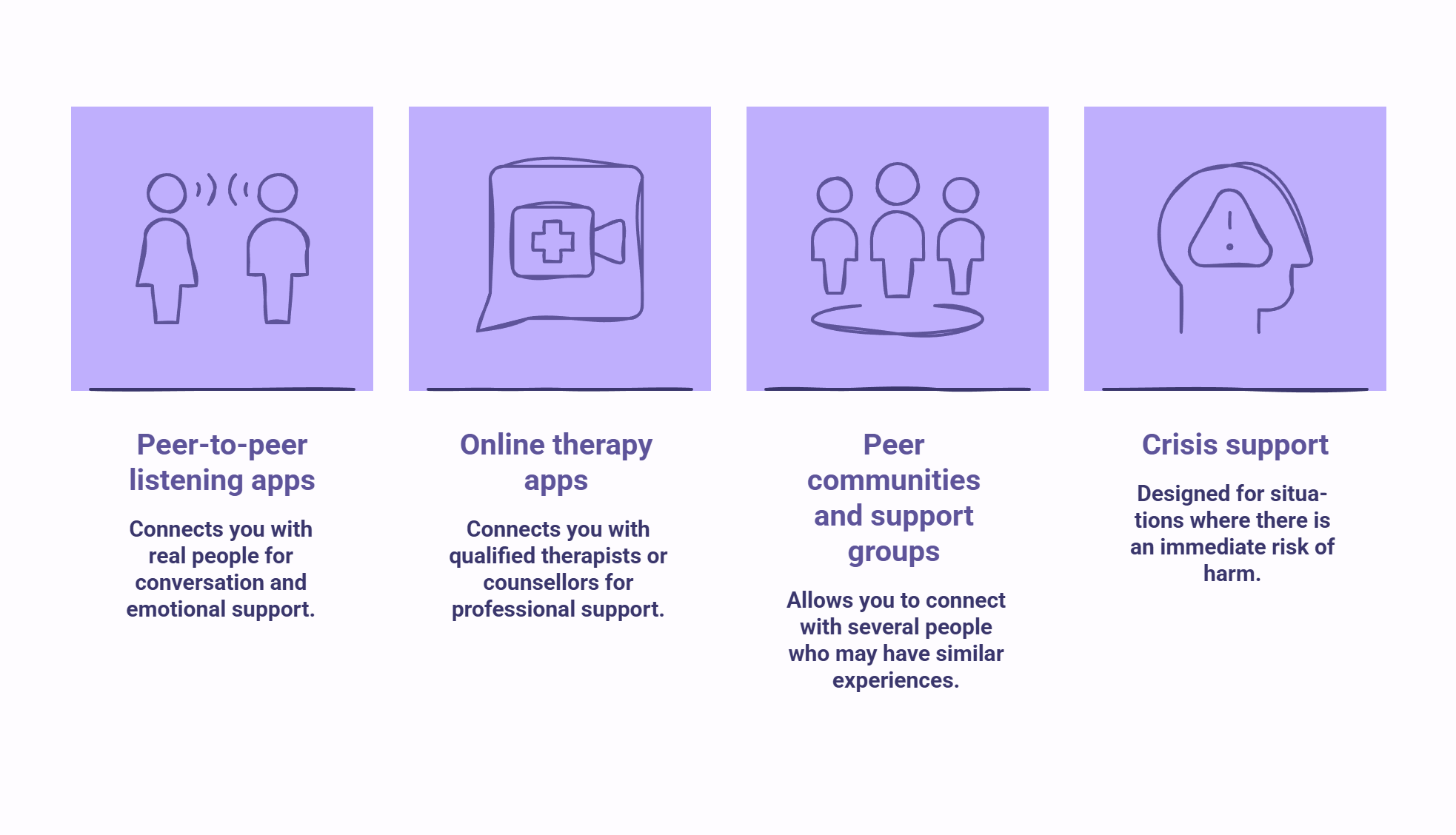
Start by deciding what you want from the conversation. If you mainly want someone to listen, you need a different service from someone seeking therapy, shared experiences, or urgent support. The key difference is who you can speak to and what support they can provide.
1. Peer-to-peer listening apps
Peer-to-peer listening apps connect you with real people for conversation and emotional support. They can help when you are depressed and need someone to talk to outside your existing relationships. Conversations may be anonymous or private, but peer listeners cannot diagnose depression, recommend treatment, or replace professional care.
2. Online therapy apps
Online therapy apps connect you with qualified therapists or counsellors through messaging, voice, or video. They provide structured professional support and may include scheduled sessions, treatment goals, and ongoing care. They can be more appropriate when depression is persistent, affecting daily life, or requires professional guidance.
3. Peer communities and support groups
Peer communities allow you to connect with several people who may have similar experiences. You can participate in discussions, share what you are going through, and hear different perspectives. Because conversations are often visible to multiple members, check the platform's moderation, privacy settings, and rules before sharing personal information.
4. Crisis support services
Crisis support services are designed for situations where there is an immediate risk of harm or you cannot keep yourself safe. They serve a different purpose from general conversation and peer-listening apps and should be used when immediate safety is the priority.
Do not choose an app simply because it is labelled a "mental health app". Choose based on who you need to speak to and what you need from the conversation, whether that is someone to listen, professional care, or urgent support.
Why might an app feel easier than talking to someone you know?
An app can remove some of the social and practical barriers that make reaching out difficult. Instead of deciding which person in your life to contact and how the conversation might affect that relationship, you can focus more directly on saying what you need to say.
1. You do not want friends or family to worry
When you are depressed and need someone to talk to, involving someone close to you can bring additional concerns. You may worry about upsetting them, being repeatedly asked how you are doing, or changing the dynamic of the relationship. Speaking through an app can keep the conversation separate from your everyday relationships while still giving you an opportunity to be heard.
2. You are worried about being judged
Opening up to someone you know can feel risky because you may continue seeing them afterwards. You might wonder whether they will treat you differently or remember what you disclosed. Talking to someone outside your social circle can reduce that concern and make it easier to discuss thoughts or feelings you normally keep private.
3. Nobody is available when you want to talk
Support from people you know often depends on their availability. If you are feeling depressed with no one to talk to at that moment, an app may give you another route to a conversation rather than requiring you to wait until a particular person is free.
4. You are not ready to book therapy
Wanting someone to listen does not necessarily mean you are ready to begin therapy. You may want to talk through what is on your mind first, without appointments or a structured therapeutic process. A peer-listening app can provide that conversational space while remaining distinct from professional mental health care.
5. You find messaging easier than speaking aloud
Some thoughts are easier to type than say out loud. Messaging gives you time to choose your words, pause before responding, and decide how much you want to share. This can make the first conversation feel more manageable when speaking by phone, video, or face to face feels difficult.
The value of an app is not simply having support available on your phone. It can reduce the barriers between wanting to talk and actually starting the conversation, particularly when existing relationships, availability, or the format of face-to-face conversation are holding you back.
What should you look for in an app to talk to someone when depressed?
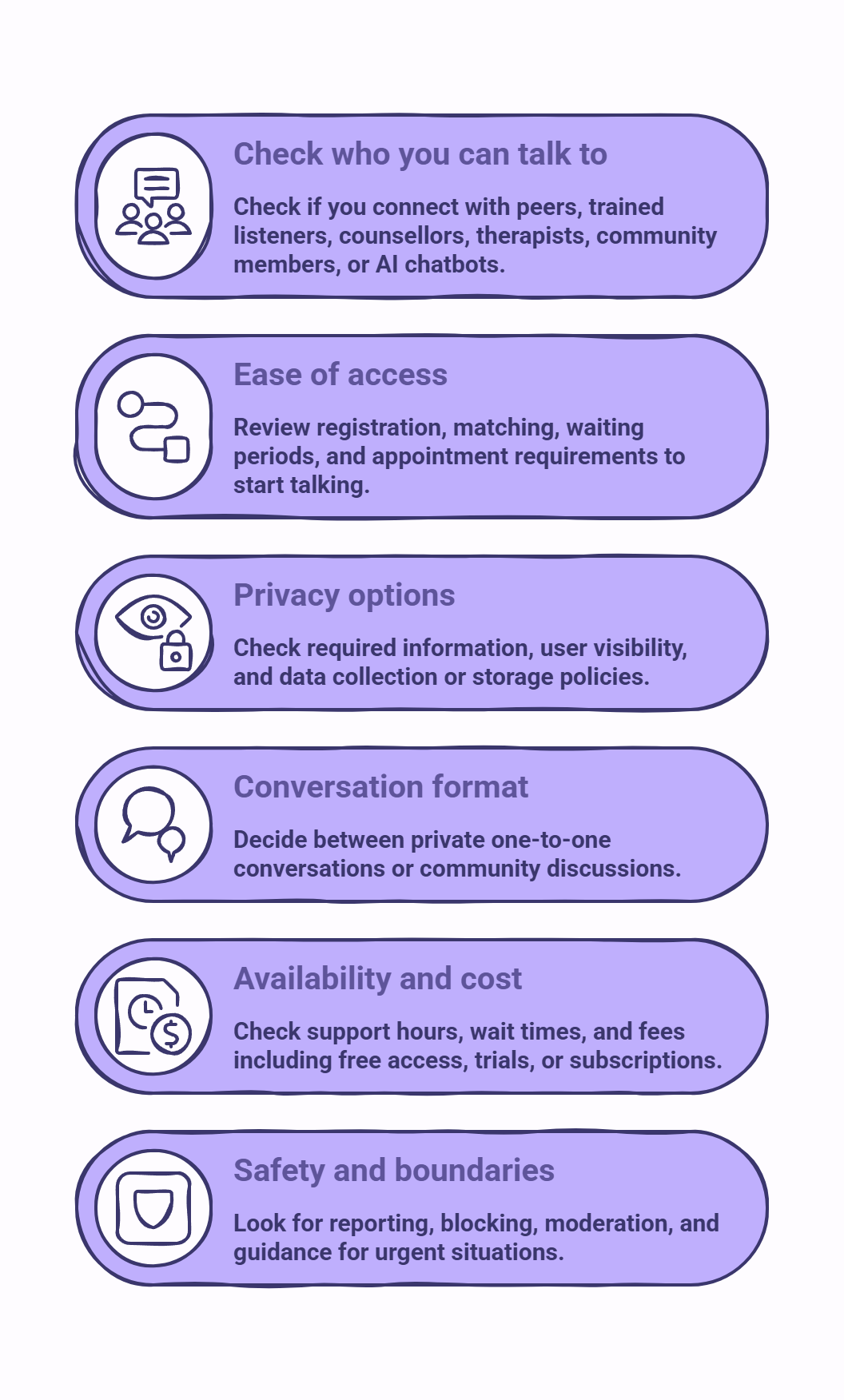
When choosing an app to talk to someone when depressed, consider who you can reach, how easily you can start talking, how private the interaction is, and what support the platform provides.
1. Check who you can talk to
Apps may connect you with peers, trained listeners, counsellors, therapists, community members, or AI chatbots. Check who responds before signing up so you know whether you are getting human emotional support, professional care, or an automated conversation.
2. Check how easily you can start talking
Review the registration, matching, waiting periods, and appointment requirements. If you mainly want someone to listen, a simpler route from opening the app to starting a conversation can make reaching out easier.
3. Review your privacy and anonymity options
Check what information the app requires and what other users can see, including your name, profile, or contact details. If anonymity is offered, also review what personal information the platform collects or stores.
4. Choose the right conversation format
Decide whether you prefer a private one-to-one conversation or a community discussion. Private messaging offers a more focused exchange, while communities provide multiple perspectives. Check who can see what you share.
5. Consider availability and cost
Check when support is available, whether matching involves a wait, and what happens when nobody is available. Review free access, trials, subscriptions, or session fees if you expect to use the service regularly.
6. Check safety measures and support boundaries
Look for reporting and blocking options, moderation policies, privacy information, and guidance for urgent situations. The platform should clearly distinguish peer emotional support from professional mental health treatment.
A suitable app to talk to someone when depressed should make it clear who you can speak to, how conversations work, and what support you can expect before you reach out.
Should you choose an anonymous app to talk about depression?
An anonymous app can make difficult conversations easier when fear of judgement or disclosure is stopping you from reaching out. If you want to talk to someone online about depression, keeping your identity separate from the conversation can give you more control over what you share.
- Less social pressure: Speaking anonymously can reduce worries about being judged or treated differently after the conversation.
- Separation from everyday relationships: The conversation stays outside your work, family, and friendship circles, which can make sensitive topics easier to discuss.
- More control over disclosure: You can decide how much personal information to reveal and avoid sharing details that are unnecessary to the conversation.
- Anonymity does not guarantee privacy: An app may still collect account, device, or conversation data even if other users cannot identify you.
- Check the privacy terms: Review what information is required to register, what the platform stores, and how your data may be used or shared.
- Protect identifying information: Avoid unnecessarily sharing your full name, address, workplace, phone number, or personal social media accounts.
Anonymity can lower the barrier to starting a conversation, but it should come with clear privacy practices and control over what you disclose.
Is it safe to talk to strangers about depression through an app?
It can be safe to talk to strangers about depression through an app, provided the platform has appropriate safeguards and you take care with what you share.
Before starting a conversation
- Check who you are talking to: Know whether they are a peer, trained listener, volunteer, or professional.
- Review safety tools: Look for clear guidelines, reporting, blocking, and crisis support information.
- Check support boundaries: Peer listeners should not diagnose conditions or provide treatment advice.
- Protect your privacy: Avoid platforms that encourage unnecessary sharing of personal or contact information.
During the conversation
- Limit identifying details: Share only what is necessary.
- Stay on the platform: Be cautious if someone asks you to move elsewhere.
- Leave uncomfortable conversations: End and report interactions that cross your boundaries.
Talking to someone outside your social circle can make opening up easier, but choose a platform with clear boundaries, privacy measures, and safety controls.
Peer-listening app or therapy app: Which should you choose?
Peer listening and therapy serve different purposes, and you do not necessarily have to choose one exclusively. The right option depends on whether you want a supportive conversation or structured help from a qualified professional.
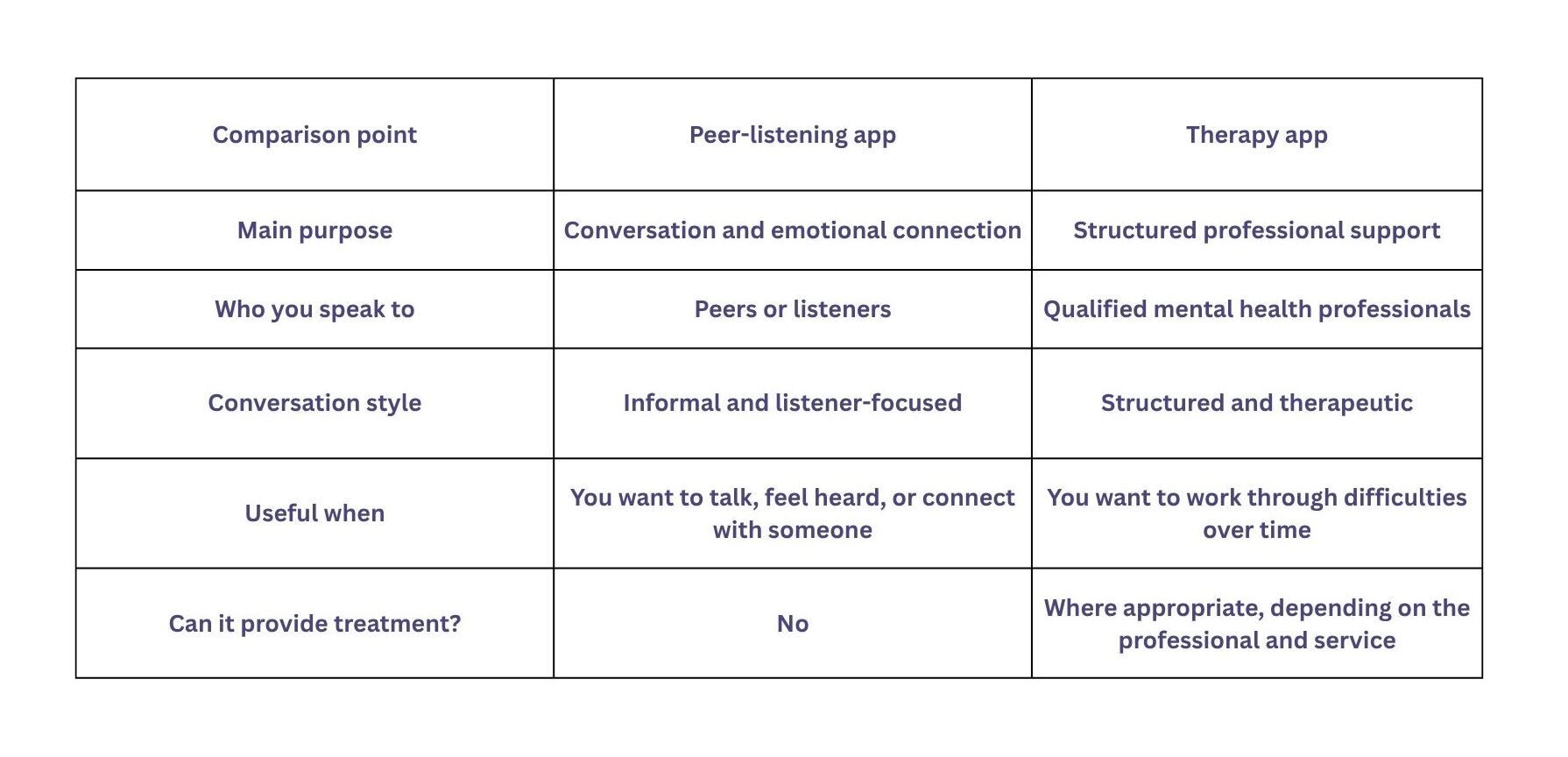
Peer listening can be useful when being heard is the immediate priority. It gives you space to express difficult thoughts and feelings without requiring every conversation to have a therapeutic goal. Therapy goes further by providing professional guidance and a structured approach to addressing mental health concerns over time.
The two can also complement each other. You might use therapy to work through ongoing difficulties while turning to peer conversations at other times for human connection and emotional support. What matters is understanding the role each option plays and using it for the kind of support it is designed to provide.
Which apps can you use when you need someone to talk to?
If you want an app to talk to someone when depressed, choose based on the type of support you need rather than simply comparing app features. Some services focus on human listening, others on peer communities, professional therapy, or self-guided support.
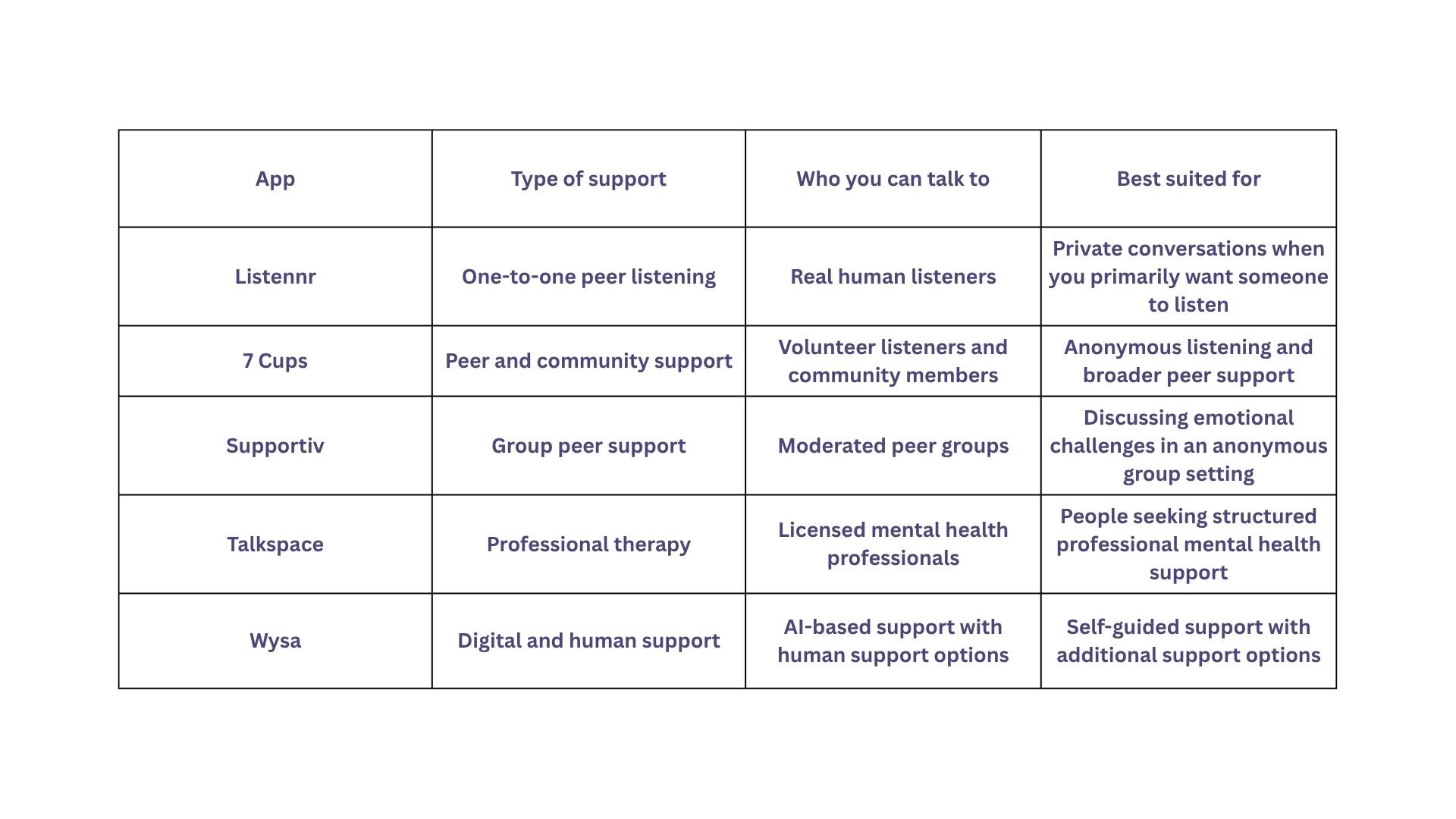
The important distinction is what you need from the conversation. If you mainly want another person to listen, a peer-listening service such as Listennr may be the more relevant starting point. If shared experiences matter more, a peer community or moderated group may suit you better.
Professional therapy platforms serve a different purpose when you need ongoing assessment or treatment, while digital tools can provide more self-guided support. These options should not be treated as interchangeable, and immediate safety concerns require appropriate crisis or emergency support rather than a general support app.
How do you get started on an app when you need someone to talk to?

When you feel depressed, need to talk to someone, but hesitate at the point of reaching out, focus on starting the conversation rather than explaining everything at once. Once you have chosen an app, these steps can help you begin.
Step 1: Set up the level of privacy available to you
Complete the sign-up process and check what information is visible to others. If the app lets you choose a display name or adjust privacy settings, use those options based on what you are comfortable sharing.
Step 2: Choose how you want to communicate
If the app offers different formats, such as text, voice, or video, choose the one that feels easiest for expressing yourself. If there is only one format, take a moment to understand how conversations work before starting.
Step 3: Connect with a listener
Follow the app's matching or connection process. If you can choose between listeners or view profiles, use the available information to find someone you may feel comfortable talking to. Otherwise, let the app connect you according to its process.
Step 4: Start with one simple message
You do not need to explain everything immediately. Your first message could be as simple as, "I've been feeling low lately and could use someone to talk to." One honest sentence is enough to begin.
Step 5: Tell the listener what you need
If you mainly want to be heard, say so. For example, "I'm not really looking for advice right now. I'd just like someone to listen." This gives the listener a clearer idea of what you want from the conversation.
Step 6: Decide what you need afterwards
Afterwards, consider whether the conversation gave you what you needed. You may want to talk again, reach out to someone you trust, or seek professional support if listening alone does not feel sufficient.
Starting does not require having the right words or telling your whole story. When using an app to talk to someone when depressed, begin with what feels manageable and let the conversation develop from there.
How can you tell whether an online conversation is actually helping?
Getting connected is only the first part of using a listening app. The more useful question is whether the conversation gives you what you came for. You do not necessarily need to feel better immediately, but there are signs that the interaction is providing meaningful emotional support.
1. You feel heard rather than managed
A useful listener gives you room to explain what is happening without immediately trying to solve it. They may ask relevant questions or reflect on what you have said, but the conversation should remain centred on what you need rather than what they think you should do.
2. You can talk without having to justify your feelings
You should not have to prove that what you are experiencing is serious enough to discuss. Responses that minimise your feelings, compare your situation with somebody else's, or tell you that you "should" feel differently can make opening up harder rather than easier.
3. The conversation helps you put thoughts into words
Sometimes the value of talking is simply being able to express something you have been carrying internally. Writing it down and responding to another person can help you identify what is bothering you, what feels most difficult, or what you may want to do next.
4. You leave with a clearer sense of what you need next
A useful conversation does not need to produce a solution. It may help you realise that you needed to be heard, want someone to talk to about depression, or would benefit from professional support. That clarity can itself make the conversation worthwhile.
5. You know when the app is no longer enough
Pay attention to whether you repeatedly seek conversations but continue to struggle in ways that significantly affect your daily life. If listening provides temporary relief without addressing what you need, it may be time to add professional mental health support rather than expecting a peer conversation to do more.
The goal is not to judge an app by whether one conversation immediately changes how you feel. Judge it by whether the interaction helps you feel heard, express what is difficult, and become clearer about what support you need next.
When is an app not enough for depression support?
A peer-listening app can give you space to talk and feel heard, but it cannot meet every support need. There are times when speaking with a GP, therapist, counsellor, or another qualified mental health professional is the better next step.
1. Your symptoms are persistent or getting worse
If low mood continues, becomes more intense, or feels increasingly difficult to manage, peer conversations may no longer be enough. A mental health professional can help you understand what you are experiencing and what support may be appropriate.
2. Depression is affecting your daily life
If how you feel is making work, study, relationships, sleep, self-care, or everyday responsibilities difficult, consider seeking professional support rather than relying on listening conversations alone.
3. You need assessment or treatment
Peer listeners can listen and offer emotional support, but they cannot diagnose depression, prescribe medication, or provide a treatment plan. For these needs, speak with an appropriately qualified professional.
4. You need more consistent support
If occasional conversations are not giving you enough support, therapy or counselling may be more suitable. It provides a regular space to work through what you are experiencing over time.
5. You are concerned about your immediate safety
If you think you may harm yourself or someone else, or you cannot keep yourself safe, do not wait for support through a peer-listening app. Seek urgent professional or emergency assistance.
An app to talk to someone when depressed can provide emotional connection, but recognising when conversation is no longer enough is equally important.
How does Listennr give you someone to talk to online?
Listennr connects you with real people for one-to-one conversations, rather than automated responses. It gives you a place to talk when you want to be heard but speaking to friends or family does not feel like the right option.
The focus is on accessible human conversation rather than therapy. You can use Listennr to express what you are feeling, talk through something difficult, or simply have someone listen without committing to a therapy session.
Listennr does not replace professional treatment or emergency support when you need it. Its role is to provide human connection and emotional support when having someone to talk to is what you need at that moment.
Feeling low and need a real person to talk to? Start a conversation on Listennr.
Find the support that meets you where you are
A good first step does not have to involve having everything figured out. An app to talk to someone when depressed can give you access to a peer conversation where you can speak openly and be heard, while a qualified mental health professional can provide assessment, treatment, or ongoing care when you need more structured support.
What matters is recognising what the conversation can realistically provide. Being heard may help you process what you are experiencing or make reaching out feel more manageable, but it should not delay professional or urgent care when your situation calls for it.
Frequently asked questions
Are there online chat services available for people who feel alone and depressed?
Yes. Online listening platforms and peer support groups can provide social support when you are experiencing feelings of sadness or other depression symptoms. For persistent or severe depression, consider speaking with a qualified professional.
I’m depressed and need someone to talk to. Can an app help?
Yes. A peer-listening app can connect you with a real person for encouragement, conversation, and social support. Platforms such as Listennr offer this option, while professional care is more appropriate for severe depression or ongoing support needs.
What should I look for in an app for depression support?
Look for access to real people, privacy controls, clear listener roles, moderation, and straightforward safety guidance. A responsible app should provide reliable health information about its limits and direct users at risk of suicide towards appropriate professional or emergency support.
Are there any safe ways to talk about depression online if I'm worried about privacy?
Yes. Choose moderated platforms with clear privacy policies, reporting tools, and defined support boundaries. Avoid sharing identifying details or seeking medical advice from unqualified users, particularly when discussing mental health problems or symptoms of depression.
Can you suggest any free mental health helplines I can call if I'm feeling depressed?
Yes. In India, Tele-MANAS provides free, confidential, 24/7 mental health support at 14416. A trained counsellor can provide immediate support and connect you with a mental health professional when further care is needed.
Should you choose an anonymous app to talk about depression?
Yes. If you want to talk to strangers about depression, an anonymous app can reduce concerns about judgement or disclosure. Check its privacy practices, safety controls, and account requirements before sharing sensitive information.