.jpg)
How to Forget an Ex When the Memories Keep Showing Up?

Key highlights
- Struggling to forget your ex is biology, not weakness or lack of effort.
- The more you force forgetting, the more strongly memories tend to return.
- Triggers like social media and shared spaces keep emotional loops active, and small changes reduce reminders.
- Healing is about creating distance from the memory, not trying to erase it.
- Talking to someone outside your usual circle can help loosen thoughts that silence tends to keep stuck.
- Avoid making major life decisions while still emotionally raw; stability supports recovery more than sudden change.
- You are not behind. Grief does not follow anyone else’s timeline, only your own.
- Listennr connects you with real listeners when memories feel too heavy to carry alone.
There's a specific kind of heaviness that comes with missing someone you're also trying to forget. You're not falling apart. You're just not fully free either. And that middle space is harder than anyone really prepares you for.
Sometimes, trying so hard to forget only keeps the memories close. The brain doesn't simply switch someone off; it lets go gradually, in its own time.
If you're wondering how to forget an ex, this guide explores small shifts that can make moving on feel more possible. Not a checklist, not a pep talk. Just a clear look at why the memories keep surfacing and the ways to forget your ex that actually shift something. It also explores what it genuinely takes to reach a place where completely forgetting your ex stops feeling like the only thing that would fix this.
Why can't you forget your ex, no matter how hard you try?

Because your brain wasn't built to let go easily. The more you try to force the memories out, the louder they get. It's not a personal failure. It's just how the mind processes losing someone who mattered.
When a relationship ends, your brain doesn't just lose a person. It loses a pattern. A whole set of daily habits, emotional anchors, and shared routines that were quietly running in the background of your life. And patterns don't disappear just because the relationship did.
There are a few reasons why thoughts about an ex can continue to surface long after the relationship ends:
1. Romanticising the relationship
After a breakup, the mind often focuses on positive memories while overlooking difficult moments. This idealised version of the relationship can make your ex seem harder to forget.
2. Ongoing social media exposure
Even occasional updates, shared posts, or mutual connections can bring old feelings back. Small reminders often interrupt the healing process and make it harder to move forward.
3. Unanswered questions and lack of closure
When a relationship ends without clear answers, the mind keeps searching for meaning. This ongoing rumination can keep emotions active long after the relationship has ended.
4. Attachment patterns that make letting go harder
People with anxious attachment styles may think about relationships for longer periods. Strong emotional bonds and fear of loss can make moving on feel more difficult.
Here's the truth about how to find peace of mind and happiness after a breakup: it rarely comes from trying harder to forget. It comes from understanding what's actually keeping the memory alive and quietly removing the fuel. That's where real distance starts.
No One Gets It? Who to Talk to When You Feel Alone. Learn how opening up can make things feel a little lighter.
Why should you avoid making major life changes right after a breakup?
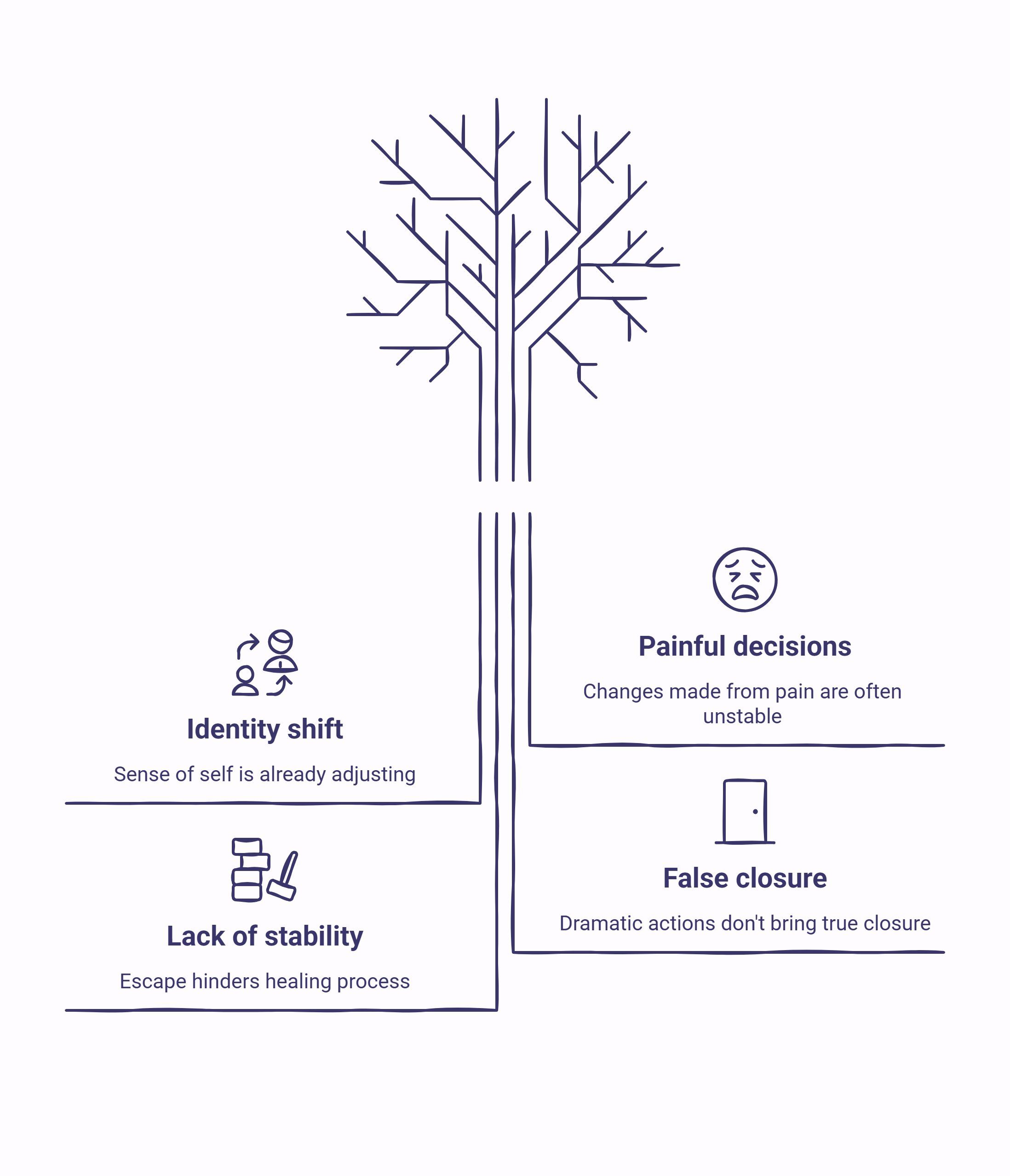
Because the version of you still moving through a breakup is often processing more emotion than clarity. That does not mean you are not capable; it simply means this is a sensitive phase where feelings can strongly influence decisions in ways that may not reflect what you truly want long term or how to completely forget your ex in a steady, healthy way.
The urge to make big changes after a breakup is completely understandable. Moving cities, changing jobs, or rebuilding your life from scratch can feel like a way to reset everything at once. Sometimes change helps, but there is a difference between thoughtful change and decisions made to escape emotional discomfort.
1. Big changes made from pain often need time to settle
Big changes made from pain often feel like relief in the moment, but may not feel the same later. Emotional decisions can reflect what you are trying to escape rather than what you truly want for your future.
2. Your sense of self is already adjusting
After a breakup, identity naturally feels a bit unsettled. Adding major life shifts on top of that can make it harder to feel grounded. Small stability in daily life often supports emotional recovery more than sudden transformation. For example, you might notice that things you used to feel certain about, like your daily routines, preferences, or even your plans, suddenly feel unfamiliar or less clear after the breakup. This shift is normal as your sense of self adjusts.
3. Closure does not usually come from dramatic actions
It can feel like starting over will bring closure, but how to completely forget your ex is usually a gradual process. Real emotional settling tends to happen quietly, through time and internal adjustment rather than big external changes.
4. Stability supports healing more than escape
Familiar routines and steady environments help your nervous system calm down. When life feels consistent in small ways, it becomes easier to process emotions without feeling overwhelmed by constant change.
You do not need to pause your life, but slowing down major decisions can help you move forward with more clarity and less emotional pressure.
Real connection starts with listening to understand, not just replying. It can quietly transform the way you relate to people.
What are the 8 best ways to forget your ex without forcing it?
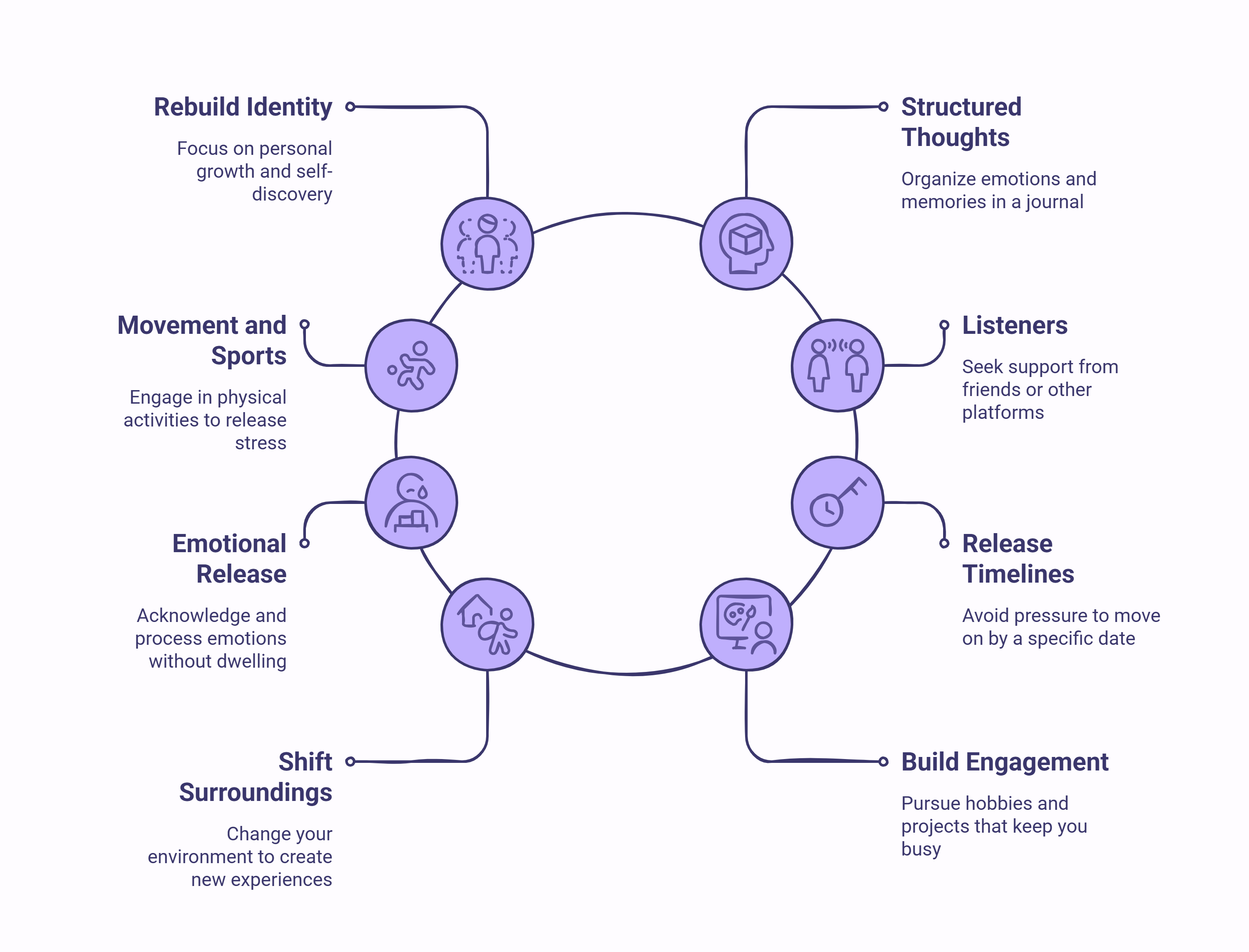
The best ways to forget your ex are not about forcing memories away, but about slowly changing how your everyday life supports those thoughts. When your routines, attention, and environment shift, emotional intensity naturally reduces and your mind begins to settle into real life again.
1. Rebuild your identity outside the relationship
After a breakup, parts of your identity can feel tied to the relationship. Reconnecting with good friends, exploring interests, and making new friendships helps you feel grounded again. It also reminds you that you are still capable of good things outside romantic relationships.
2. Give your thoughts a structured space
Instead of trying to control your feelings all day, allow a short window to process thoughts. Outside that time, gently redirect your attention. This builds healthier control of your feelings without suppressing them, which often makes emotional waves easier to manage.
3. Replace scrolling with movement and sports
Scrolling through social media posts often keeps the mind stuck in comparison and repetition. Choosing movement instead, like walking, gym workouts, or sports, helps shift energy into your body. This is often the first place where emotional tension begins to release.
4. Talk to someone who can simply listen
Sometimes you do not need advice, just space to be heard. Speaking to someone outside your immediate circle can feel grounding. Platforms like Listennr offer a space where you can connect with real people who listen without judgment, which can make a surprising difference on the days when the memories feel loudest and your usual support system feels too close to the situation.
5. Allow emotions without staying stuck in them
It is natural to feel sadness or miss good times after a breakup. The most important thing is not to let those thoughts loop repeatedly. Acknowledge what you feel, then gently return to the present instead of replaying the same memories. Over time, this helps your nervous system settle instead of staying emotionally activated.
6. Release the pressure of timelines
There is not only one way or a fixed timeline for healing from romantic relationships. Comparing your progress to others often adds stress. In the long run, acceptance grows when you stop measuring where you “should” be. Healing becomes lighter when you permit yourself to move at your own pace.
7. Shift your physical surroundings
Your environment can keep memories active without you realising it. Small changes like visiting a new city, rearranging your space, or taking different routes help reduce emotional triggers and create fresh associations in daily life. Even small visual changes can quietly shift how your mind responds over time.
8. Build something that keeps you engaged
Working on something meaningful helps redirect focus away from the past. Learning skills, fitness goals, or creative projects can support better choices that move you forward. Over time, this becomes a strong anchor in your first place of emotional stability.
Over time, these changes do not erase memories, but they help you regain balance. The goal is not forced forgetting, but creating space where your mind is no longer defined by what happened before.
If you have been wanting to talk to someone, Check out the simple ways to start a conversation online today.
How to deal with emotional triggers in everyday life?
Emotional triggers can show up unexpectedly in daily life through places, songs, routines, or even passing thoughts. If you are wondering whether you ever truly forget your ex, it helps to understand that it is less about complete forgetting and more about learning how to respond when memories are triggered.
- Pause before reacting: When a trigger appears, take a brief pause instead of following the thought. This small gap reduces emotional intensity and helps you regain control.
- Shift into physical movement: Simple actions like walking, stretching, or changing your posture can break the emotional loop and bring attention back to the present.
- Stop the memory loop early: Avoid replaying conversations or moments in your head. Gently redirect your focus before the thought deepens.
- Build new associations: Use familiar places in new ways, like going with friends or changing routines, so old spaces start to feel neutral again.
- Express instead of holding in: Writing or talking about what you feel helps release emotional pressure and makes triggers easier to process.
- Ground yourself quickly: Focus on your breath, sounds, or surroundings to bring your attention back when emotions feel overwhelming.
The triggers lose their intensity over time. You may still notice them, but they no longer control your emotional state the way they used to.
For more clarity, explore the practical ways to respond when someone opens up about depression and anxiety.
Life beyond the relationship: Redefining what makes you feel alive
After a breakup, it is okay to feel like a part of your emotional world has gone quiet. The routines, the shared meaning, and even the sense of anticipation in everyday life can feel reduced. But life beyond the relationship is not about replacing what was lost. It is about slowly rediscovering what still makes you feel present, connected, and alive in your own way.
This phase is less about forcing positivity and more about noticing what still brings a sense of energy, even in small moments. It can be simple things like movement, conversations, curiosity, or time spent doing something that does not revolve around the past. These experiences begin to rebuild emotional momentum gradually.
Redefining what makes you feel alive also means allowing yourself to explore without pressure. You do not need to have everything figured out. You only need to stay open to new experiences, new connections, and new versions of yourself that are not tied to the relationship you are moving away from.
Over time, life starts to feel less like something you are recovering from and more like something you are gently returning to. That shift is where real emotional rebuilding begins.
When you need someone who truly gets you, this is where it begins. A small step that can help you find the right kind of support.
Could talking to a stranger help you finally move on from your ex?
It might sound unlikely, but talking to someone who has no connection to your ex can feel unexpectedly freeing. There is no shared history, no opinions about the relationship, and no emotional context to manage. That makes it easier to speak honestly, without filtering yourself or worrying about how you are being perceived.
Listennr connects you with real, trained listeners who are there just to hear you out. It is not therapy, and it is not a hotline. It is a private, judgment-free space where you can say what has been on your mind to someone who is simply present and listening.
- You get trained listeners who are there simply to hear you out
- No judgment, no unsolicited advice, and no pressure to explain everything perfectly
- Fully anonymous, so you can speak openly and honestly
- Private and encrypted conversations every time
- Available anytime, without appointments or waiting rooms
- Text or voice, depending on what feels more comfortable for you
Sometimes what helps most is not advice, but being heard by someone who has no stake in your story. That kind of space can make it easier to process what you are carrying and slowly move forward. Talk to a Listennr today.
Learning to let go without forcing it
Moving through a breakup is not about erasing memories or forcing yourself to forget someone overnight. It is about slowly creating enough emotional and practical distance so those memories stop feeling so heavy in your everyday life. Over time, what once felt overwhelming begins to lose its intensity as you rebuild your focus on yourself.
A simple next step can be as small as choosing one habit to change today, whether that is limiting a trigger, spending time in movement, or reconnecting with something that feels like yours again. Small actions matter more than big emotional decisions.
Be gentle with yourself through this process. Healing is rarely linear, and there is no fixed timeline you are supposed to follow. With time and steady effort, things that feel sharp right now will start to feel more manageable, and life will gradually feel like it belongs to you again, allowing you to build a healthy relationship with yourself.
Frequently asked questions
How long does it usually take to forget your ex?
Everyone heals at a different pace depending on attachment, breakup circumstances, and emotional health. The grieving process looks different for everyone. What matters is steady healing, not speed.
Is it helpful to stay friends with your ex after a breakup?
It helps only if it does not reopen emotional attachment. If contact brings hope, confusion, or pain, distance supports healing. Space often creates clearer closure before considering new relationships.
What can I do if reminders of my ex keep appearing?
Identify triggers and reduce them where possible, like storing keepsakes or limiting updates. Changing routines helps too. This supports emotional processing and gives your mind space to settle naturally.
How do I stop being in love with my ex?
You cannot switch off feelings instantly, but you can weaken attachment by reducing triggers, limiting contact, and focusing on new routines, relationships, and personal growth that shift emotional dependence.
How to stop replaying memories of your ex?
Notice when the loop starts, then gently redirect your attention to a present activity. Reducing triggers and staying engaged in physical or meaningful tasks helps interrupt repetitive thought patterns.